
A pharmaceutical vacuum emulsifier goes through more scrutiny than almost anything else on the line. The formulation may be simple - an ointment base, a topical cream, a gel - but the machine behind it has to satisfy an auditor as well as a process engineer. The difficulty is that most emulsifier quotes are written for cosmetics: capacity, homogeniser power and jacket pressure, and nothing about surface finish reports, welding documentation, CIP coverage or electronic batch records. Buyers usually discover the gap during qualification, when it is expensive to close.
This article covers what to write into a vacuum emulsifier specification for a pharma dosage form, in the order a project actually hits each decision.
Why pharma specification differs from cosmetics
Cosmetics plants and pharma plants often run the same machine platform. The Ginhong RX and RS series both appear in skin-care production and in topical-pharma production. What changes is not the mixing action; it is the evidence you have to produce afterwards. A cosmetic line has to make a stable, repeatable product. A pharma line has to make the same product and then prove, in writing, that the vessel it was made in was clean, validated and controlled. Specification work therefore shifts from performance towards provability.
- Cleaning: cosmetics plants clean between products; pharma plants clean between products and document that residue is below a validated limit.
- Material evidence: pharma buyers need certificates and weld records tied to the actual vessel, not a generic datasheet.
- Control records: electronic recipe control with an audit trail moves from nice-to-have to requirement.
- Change control: once equipment is qualified, replacing a gasket supplier becomes a documentation task - so it pays to over-specify at order stage.
Start with the dosage form, not the machine
The most useful first question is what the vessel will actually run. Dosage form decides whether you need a homogenising vessel at all.
Ointments, creams and gels
These are the natural fit for a vacuum emulsifier. You are building an emulsion or a structured semisolid, so you need the three working actions the machine provides: slow wall-scraping agitation to keep product moving and heat transferring, high-shear homogenisation to reduce droplet or particle size, and vacuum to strip entrained air before filling. Vacuum matters more in pharma than in cosmetics, because entrained air changes fill weight, and fill weight changes dose.
For 50-500 L topical batches the RS series is the usual match. For 500-2000 L production the RX series is the standard choice, and above that - or with higher-viscosity bases - the RB series takes over. All three are available with SS316L contact parts and a mirror-polished finish, and all are CE certified.
When a vacuum emulsifier is the wrong tool
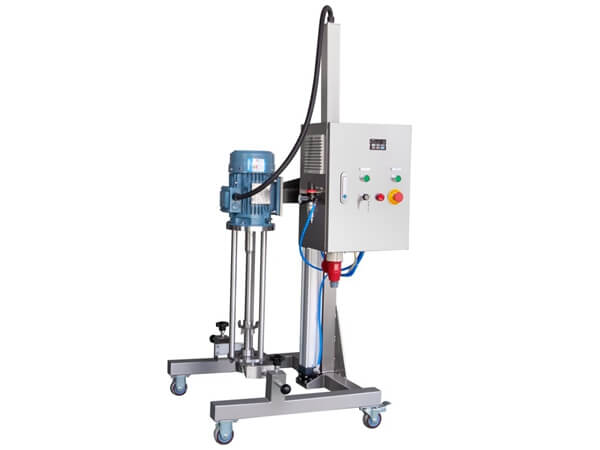
Syrups, suspensions and solutions are not emulsions and do not need a homogeniser. Running a clear or low-viscosity liquid in a vacuum emulsifier wastes capability. A high-shear mixer such as the SF or ZX series in a jacketed tank is usually the better match, and a CG mixing or storage vessel covers hold and transfer steps. Hot-melt and very high-viscosity dosage forms such as suppository bases sit between the two: temperature-critical and thick, and normally better served by a PD or PX planetary mixer.
Cleanability by design: surface finish, geometry and CIP
Two things decide whether a vessel is cleanable: how smooth the product-contact surface is, and whether the geometry leaves anywhere for product to sit. Get both right at order stage and cleaning validation becomes a routine project. Get them wrong and you spend the next two years cleaning around your own equipment.
Surface finish and geometry
SS316L contact parts, mirror polished to Ra ≤ 0.4 µm, is the standard specification for pharma work. That finish comes from mechanical polishing followed by passivation, and it should arrive with a report rather than a claim.
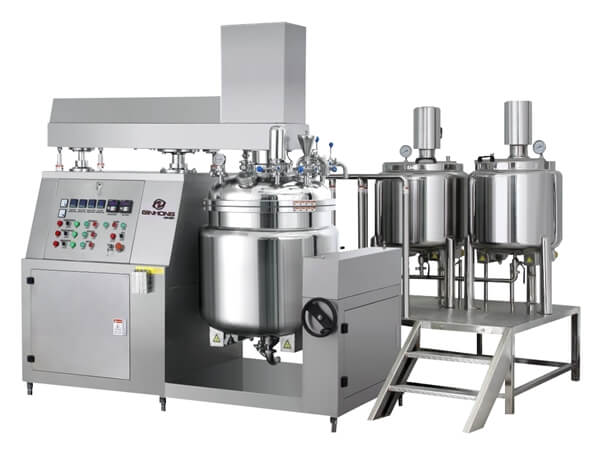
Ra is an average roughness, not a maximum, so agree the acceptance criterion and the measurement method up front. How the surface was measured matters more than the number printed on a datasheet.
- No dead corners: the agitator-to-wall gap, the bottom discharge valve seat and the lid gasket groove are the three places residue hides. A scraping agitator that follows the vessel contour to within a few millimetres also removes the stagnant boundary layer where product can overheat.
- Drainability: the vessel should empty by gravity through the discharge valve with no pooled pocket. A flat bottom with a side outlet does not.
- Wetted fasteners: avoid exposed threads inside the vessel. Clamp or flange connections with sanitary gaskets are easier to clean and easier to swab.
- Lid and sight glass: a lifting or hinged lid with a hygienic observation port lets an operator confirm cleanliness without entering the vessel.
CIP coverage and swab points
Almost any tank can be cleaned to a validated level given enough time and labour. The real question is whether the machine lets you do it quickly, reproducibly, and with swab points you can actually reach. A vacuum emulsifier designed for clean-in-place coverage will have spray coverage of the headspace, the lid and the underside of the agitator, a fully drainable bottom, and no crevices that trap product.
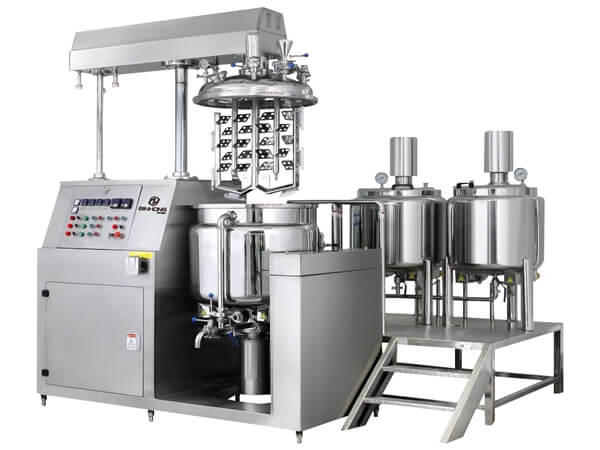
- Spray coverage: one ball in the headspace is often not enough on a tall vessel. Ask for the coverage calculation, not just the ball count.
- Swab point accessibility: agree the swab locations with your QC team before the machine is built. The discharge valve, agitator shaft seal area, lid gasket and homogeniser shaft are the usual worst cases.
- Drain slope and no reflow: cleaning solution should leave without pooling. Confirm the bottom cone angle and the valve type.
- Starting-point CIP recipe: the supplier should be able to state detergent concentration, temperature, time and flow that you then validate on your own product.
- Shaft seal design: a double mechanical seal with flush is easier to clean than a lip seal, but you have to supply the flush medium.
CIP readiness is a design property. Cleaning validation is a project outcome. Buy the first so you are not fighting for the second.
The documentation package to ask for in the quote
This is where quotes differ most, and where the cheapest offer usually turns out to be the most expensive. A pharma-ready order should name its documentation deliverables in the purchase specification.
- Material certificates: EN 10204 3.1 mill certificates for SS316L product-contact plate, tube and forgings, traceable to the vessel serial number.
- Weld documentation: welder qualification, weld map, and inspection records for hygienic welds.
- Surface finish report: measured Ra values by zone, with the instrument and method stated.
- Gasket and seal declarations: material statements so you can check compatibility with your product and your cleaning solvent.
- CE declaration of conformity and electrical drawings for your own qualification file.
- IQ/OQ scope: agree which documents the supplier authors and which you author, plus factory acceptance test records, instrument calibration certificates and a spare-parts list with part numbers.
- Instrument list: every sensor - temperature, pressure, vacuum, load cell - with range, accuracy and calibration interval.
Ask at quote stage. Requests added after the machine is built are rework, and rework inside a qualified system means change control.
Controls, electronic records and batch traceability
A modern vacuum emulsifier runs from a recipe rather than a bank of switches. On a pharma order that means the control system should support recipe management, user access levels, alarm history and an audit trail. For plants supplying the US market, 21 CFR Part 11 readiness is the specification to raise: it concerns who can change a record, when, and whether the change is traceable.
- Recipe management: recipes stored and versioned in the controller instead of typed in by hand from a batch sheet.
- Audit trail: changes to setpoints, recipes and user rights logged with user, timestamp and old/new value.
- User access: operator, supervisor and engineer levels, with electronic signature where your procedure requires it.
- Data export: the ability to pull batch data out for review rather than reading values off a screen.
- Calibration: a temperature or vacuum reading is only as good as its calibration. Fix the range and the calibration interval at order time.
None of this is exotic, but it is easy to leave out of a quote that was built on mixing performance alone.
Vacuum, heat transfer and the utilities behind them
A vacuum emulsifier does most of its work while heated, then cools in the same vessel before discharge. On pharma batches that thermal cycle is part of the process record, so it is worth specifying precisely rather than approximately.
- Vacuum level: many topical and cosmetic emulsions are processed around -0.06 to -0.09 MPa. State the level you need and confirm the pump and vessel can hold it.
- Jacket duty: the jacket has to both heat and cool. Confirm the heating medium available to you - steam, hot water or electric - and the cooling water temperature and flow your plant can actually deliver.
- Cooling rate: cooling capacity per minute scales with vessel size. A batch that cools in 40 minutes at pilot scale can take over an hour at 2000 L on the same chiller.
- Vacuum pump type: water-ring pumps are the usual choice; a dry pump avoids a liquid effluent stream, which is easier to justify in a pharma utilities room.
- Compressed air: pneumatic valves need clean dry air at stable pressure. Confirm the peak demand with all valves actuating at once.
Give the supplier real utility figures instead of a general range. A machine specified against the wrong cooling water temperature will either run slow on every batch or fail to hold the temperature profile you validated.
Prove the process at lab scale before you commit
The cheapest way to de-risk a pharma emulsifier purchase is to settle the process on a small machine first. A JX lab mixer or a lab-scale vacuum emulsifier lets you fix the order of addition, the homogenisation speed and time, the vacuum level and the temperature profile on a few hundred grams - then scale those parameters up instead of guessing at them.
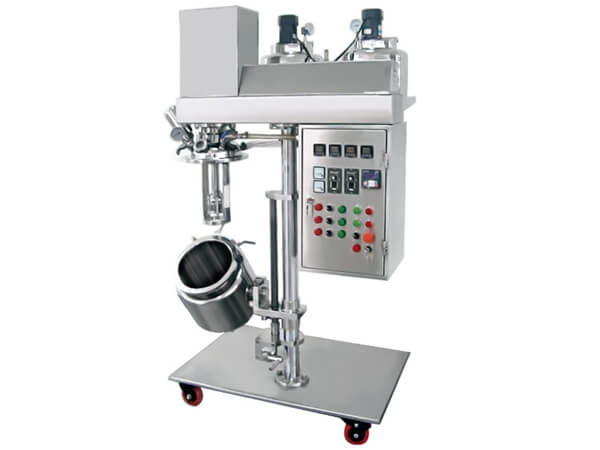
Run at least three batches at pilot scale on the same recipe and compare droplet size, viscosity and appearance against the lab result. If those three agree, you have a process that will scale. If they drift, you have found the problem while a 100 L machine is still cheap to adjust.
The bottom line
Specify a pharmaceutical vacuum emulsifier on evidence, not just capacity. Confirm the dosage form is genuinely an emulsion before choosing a homogenising vessel. Write SS316L contact parts at Ra ≤ 0.4 µm with no dead corners into the specification, and ask for the measured surface report that proves it. Buy CIP readiness as a design feature, then validate cleaning on your own product. List the documentation deliverables - material certificates, weld records, surface reports, IQ/OQ scope, instrument calibration - inside the quote, not after it. Check vacuum level and jacket heating and cooling against your real utilities, and settle the recipe on a lab or pilot machine before signing for a production vessel.
Continue reading
RS vs RX vs RB Vacuum Emulsifier: Which One for Your Batch Size
Three vacuum emulsifier series, three different jobs — here's how to pick the right one without over- or under-sizing your line.
Read article → PROCESS KNOWLEDGE · 2026-09-04How to Scale Cosmetic Cream Production from Lab to 2000L
Moving a formulation from a beaker to a full production vessel changes the physics of mixing — here is how to plan the scale-up without losing stability.
Read article → PROCESS KNOWLEDGE · 2026-09-03How Is Mayonnaise Made in a Factory: The Mixing Line Explained
A step-by-step look at the mixing process that turns oil, water, egg and vinegar into a stable industrial emulsion.
Read article →Have a process question?
Send it to our engineers. We read every inquiry and reply within 24 hours.
Ask an Engineer →