
A cream that leaves the vessel looking perfect and separates in the jar two weeks later is one of the most expensive failures in cosmetic and personal-care manufacturing. The raw material, the energy and the shift are already spent, and the usual reaction — reformulate — is often the wrong one. In most cases the formulation is sound and a process variable has drifted: a temperature step skipped, a high-shear stage cut short, or air that never left the batch. This guide walks through the defects that come up most often on vacuum emulsifier lines, what each one actually means, and the checks that fix it.
Read the symptom before you touch the machine
Before changing anything, classify the defect. Separation, aeration, grit and viscosity drift have different root causes, and the same adjustment will fix one and make another worse. Note down the moment the defect first appears — in the vessel, at discharge, after 24 hours, or after a week — because the timing is usually the strongest clue you have. A batch that separates immediately is a droplet-size problem. One that separates after a week in the jar is more often a stability or preservation problem, which is a completely different investigation and not one that mixing parameters will solve.
That distinction matters commercially as well as technically. Reworking a batch costs the materials and the shift. Reforming a product that was never at fault costs the development work, the stability study and the customer's patience.
- Oil on top or a watery layer at the bottom: droplets were never small enough, or they coalesced during cooling.
- Dull, grey surface or visible bubbles: air left in the batch, usually because vacuum was applied too late.
- Grit or soft beads in the cream: powder hydration, not shear capacity.
- Viscosity that moves between identical batches: weighing accuracy, evaporation loss, or a temperature step that ran short.
- Heating or cooling far slower than the recipe allows: jacket utilities, fouling, or a batch mismatched to the vessel.
Cream that separates or oils off
If oil rises to the top, the dispersed droplets were either never reduced far enough, or they were fine at the end of mixing and then merged back together during cooling. That second path is the one most often missed. Many waxy emulsifiers crystallise across a narrow temperature band, and a batch that sits in that band while being sheared at the wrong intensity can lose the structure it had. The cream looked right at discharge, which is why nobody suspects the cooling ramp.
What is happening inside the vessel
Droplet size is set by the energy you put into the batch — the tip speed of the rotor-stator homogenizer and how long you run it — and by how quickly the emulsifier can reach the fresh oil-and-water interface that mixing keeps creating. If the emulsifier is not fully dissolved, or the oil phase is added faster than the interface can be covered, no amount of extra mixing afterwards will recover the batch. You will only make it colder and more aerated.
Under-dosing is the other common cause, and it hides well. A weighment that is a few percent light on the emulsifier can pass a visual check and still give you a product that breaks in a month. If you want the mechanics from first principles, how a vacuum emulsifier homogenizer works covers the full cycle step by step.
Fixes that work
- Hold both phases at the specified temperature before combining, and verify with a calibrated probe rather than the jacket readout — the two can differ by several degrees.
- Add the oil phase slowly and under agitation, so the emulsifier is never locally overwhelmed.
- Run the homogenizing stage long enough to reach a uniform droplet distribution. Judge it by appearance and by a microscope or particle-size check, not by a fixed number of minutes copied from a lab sheet.
- Stop high shear before the crystallisation range and finish cooling under slow anchor agitation only.
- Reconcile the phase ratio by weight after the batch rather than trusting the recipe on paper.
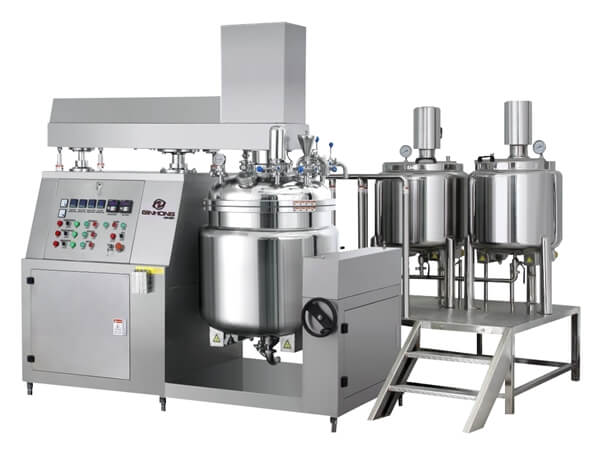
Air bubbles and a dull surface
A glossy cream is a dense cream. Entrained air scatters light, which is why an aerated batch looks grey and matte instead of bright, and it also raises the oxidation load on sensitive actives such as retinol and vitamin C derivatives. Air gets in at three points: with the powder charge, through any gap between the batch surface and the lid, and from the vortex a fast agitator pulls when the vessel is only partly filled.
- Pull vacuum before the high-shear stage, not after. Deaerating a finished cream is slow and rarely complete, because the structure already traps the bubbles.
- Charge powders through the powder inlet under vacuum so you add product rather than a pocket of air with every addition.
- Keep the slow agitator below vortex speed until the vessel is properly loaded.
- Check the lid gasket and shaft seal first if vacuum will not hold. Mechanical leaks are cheaper to fix than a reformulation.
- Do not overfill. A vessel filled to the top has no headspace for the foam that forms during homogenizing, so the foam ends up in the product.
Aeration also distorts fill weight. If your filling line doses by volume, a batch carrying two or three percent air will fill light, and that shows up as a customer complaint rather than as a mixing problem.
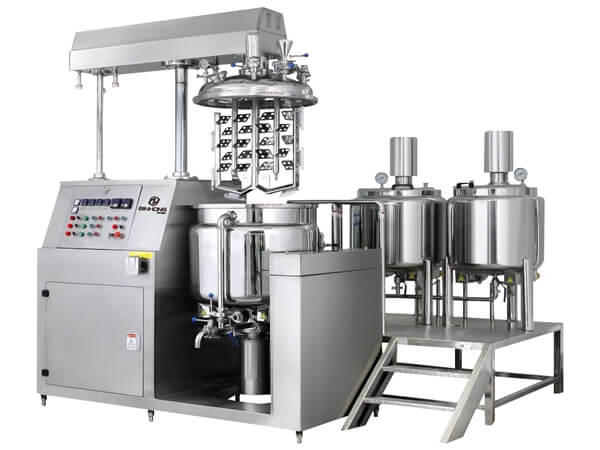
Grit, graininess and fish eyes
Grit is usually a hydration problem rather than a shear problem. Thickeners such as carbomer, xanthan and cellulose swell from the outside in. When they hit the water as a lump, the outer layer gels and seals the dry core, leaving a soft bead that a rotor-stator head will push around rather than break down cleanly. The same mechanism produces fish eyes in anything that swells, including some clays and film formers.
- Control the feed rate. Add powders into the vortex slowly, or pre-slurry them in a side vessel and meter the slurry in.
- Give gums a real hydration window at low shear before the homogenizer starts.
- Measure the rotor-stator gap. Wear increases the gap over time, which drops the shear rate even though the motor is still at full speed.
- For pigments and mineral UV filters, a dedicated high-shear disperser ahead of the emulsifier does the deagglomeration faster and saves wear on the homogenizer.
If grit appears only in the first batch of the day, suspect carryover rather than the formulation. Dried product on the discharge valve, in a sampling port or behind a baffle will flake off into the next charge. A mirror-polished SS316L contact surface with no dead corners makes a full CIP cycle realistic, which is the practical defence against this whole class of defect.
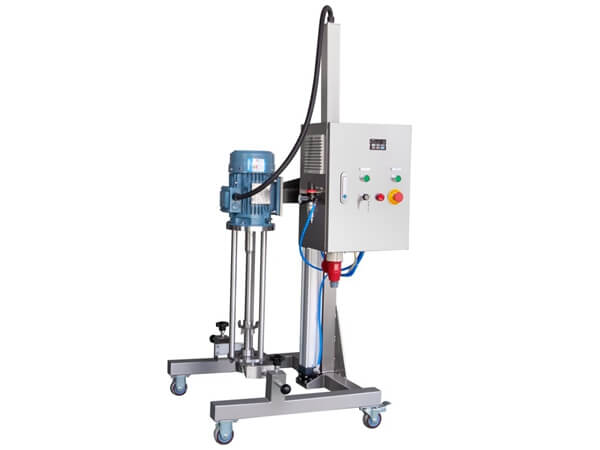
When the vessel will not hold vacuum
Vacuum is what separates an emulsion from an aerated dispersion, so a vessel that cannot reach or hold its target is a production problem, not just a maintenance nuisance. Work from the outside in — most leaks are cheap and obvious once you look in the right order, and they almost never require taking the machine apart.
- Inspect the lid gasket for cuts, flattening or dried product residue.
- Check the mechanical seal and its barrier fluid. A seal running dry loses vacuum and, worse, can contaminate the batch.
- Confirm the vacuum pump and any inline filter are serviced. A blocked filter presents exactly like a leak.
- Verify that every valve is seated, including the sampling and bottom discharge valves, which are easy to leave cracked.
- Question the gauge. An instrument that reads low across every batch, on every product, is an instrument problem.
If the vacuum holds but the product still looks aerated, the issue is timing rather than hardware. Vacuum has to be applied while the batch is still mobile and warm. Once the structure sets, the bubbles are trapped and no pump will pull them out.
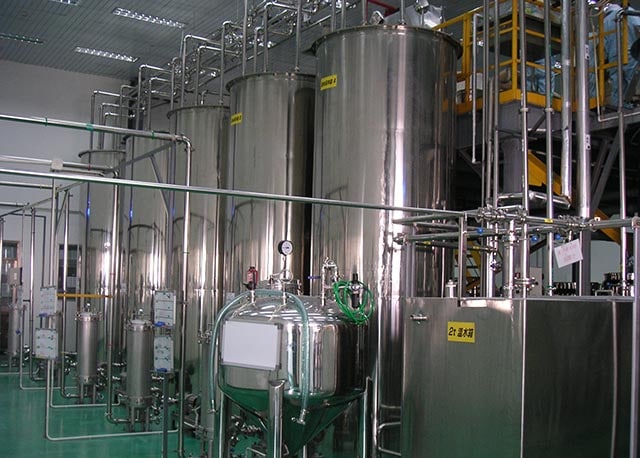
Viscosity that drifts between identical batches
When the same recipe on the same machine gives a different viscosity every time, look for small losses rather than big causes. Water evaporates during a long heating stage. Powders hold different moisture depending on the season and the supplier lot. A weigh hopper that is not zeroed between charges shifts the phase ratio by more than anyone expects, and the effect lands squarely on viscosity because gum systems are steeply non-linear near their target.
- Weigh every charge. Do not dose by level, by pump runtime or by number of scoops.
- Record the discharge temperature. Viscosity measured hot and cold are not comparable, and most shop-floor viscometers are temperature-sensitive.
- Make up evaporated water at the end of the cycle if the process runs long and hot.
- Standardise the shear stage: same rotor speed, same duration, same fill level. Viscosity built by a gum is largely set by how that gum was dispersed.
- Keep a retained sample per batch at a controlled temperature, so you have a reference when a complaint arrives months later.
It is worth keeping one small machine for this work. Running a suspect formulation on a lab-scale unit such as the JX, at a few litres, tells you within one shift whether the drift comes from the raw material or from the process — before you write off a full production vessel. If the answer turns out to be capacity or configuration rather than procedure, the vacuum emulsifier buying guide covers how to size the next machine.
The bottom line
Most cream defects trace back to four variables: the temperature at which the phases meet, how hard and how long the high-shear stage runs, how much air is still in the batch when the structure sets, and whether the recipe was actually weighed. Check all four before you touch the formulation. A vacuum emulsifier — RS, RX or RB — will reproduce whatever process you give it, so when a batch fails, the procedure is the first place to look and usually the last place anyone looks. Keep a written batch record with temperatures, times and vacuum levels for every run, and the next failure will take minutes to diagnose instead of a shift.
Continue reading
GMP Vacuum Emulsifier Design: What to Specify for Pharma
What to lock down on a pharmaceutical vacuum emulsifier - surface finish, CIP, documentation and controls - before you sign the quote.
Read article → MACHINE COMPARISON · 2026-09-12RS vs RX vs RB Vacuum Emulsifier: Which One for Your Batch Size
Three vacuum emulsifier series, three different jobs — here's how to pick the right one without over- or under-sizing your line.
Read article → PROCESS KNOWLEDGE · 2026-09-04How to Scale Cosmetic Cream Production from Lab to 2000L
Moving a formulation from a beaker to a full production vessel changes the physics of mixing — here is how to plan the scale-up without losing stability.
Read article →Have a process question?
Send it to our engineers. We read every inquiry and reply within 24 hours.
Ask an Engineer →