
Key Takeaways
- Five steps: load the phases into the jacketed vessel, draw vacuum to around −0.09 MPa, homogenize under vacuum, cool while mixing, then discharge.
- Vacuum matters more than speed — no amount of shear fixes air that has already been beaten into the batch.
- The homogenizer rotor spins inside the stator at high speed, up to roughly 3000 rpm, pulling product in and forcing it through the narrow stator slots.
- Slow, continuous anchor motion during cooling is what locks the emulsion structure in place.
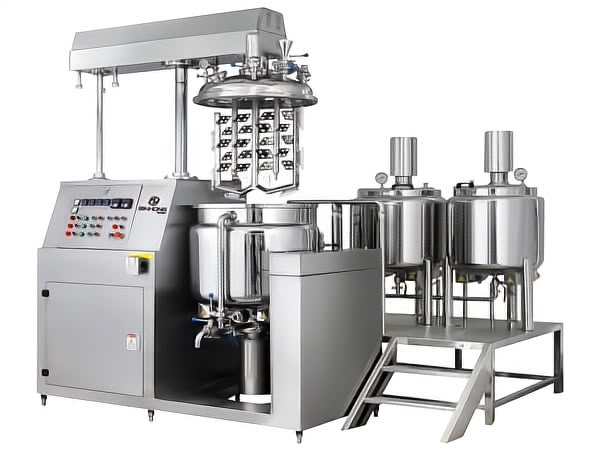
A vacuum emulsifier homogenizer looks complicated, but its job is simple: combine an oil phase and a water phase into a fine, stable, air-free emulsion — and keep it stable. It does this by combining three actions in one closed vessel: slow agitation, high-shear homogenization, and vacuum. Here is what happens, step by step.
The three working parts
- The anchor agitator — a slow, wall-scraping paddle that keeps the batch moving and prevents product from sticking or burning.
- The high-shear homogenizer — a rotor-stator head that breaks oil and water into fine, uniform droplets.
- The vacuum system — draws air out of the vessel so bubbles never form in the first place.
Step 1: Load the phases
The raw materials are introduced into the jacketed vessel — typically the water phase first, then the oil phase. The jacket lets you heat the contents to the temperature your formulation needs, usually while the anchor agitator turns slowly to distribute heat evenly.
Step 2: Draw vacuum
Once the vessel is sealed, the vacuum pump evacuates air to around -0.09 MPa. This does two things: it prevents oxygen from degrading heat-sensitive actives, and it stops micro-bubbles from being whipped into the product. Some machines also use vacuum to pull raw materials in, which reduces dust and manual handling.
Step 3: Homogenize under vacuum
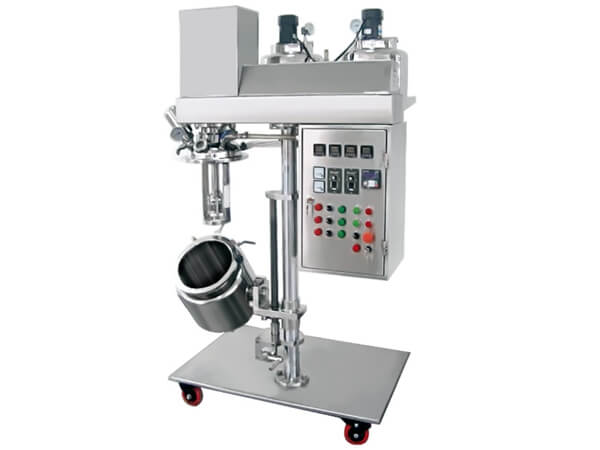
With the anchor still turning, the homogenizer spins its rotor inside the stator at high speed (up to ~3000 rpm). Product is pulled into the head and forced through the narrow stator slots, where intense shear tears the oil droplets apart into micron-sized droplets. Under vacuum, these droplets stay free of air and remain uniformly dispersed.
Step 4: Cool while mixing
Once the emulsion is formed, cooling water or chilled fluid runs through the jacket while the anchor agitator continues to turn. Slow, continuous motion during cooling is what locks the emulsion's structure in place and prevents separation or "creaming" as the batch thickens.
Step 5: Discharge
Finally, the finished product is discharged — often through a bottom valve or by tilting the vessel — into storage or directly into filling. Because the process happened under vacuum, the batch leaves the machine smooth, uniform and free of trapped air.
Why vacuum matters more than speed
It is tempting to think a faster homogenizer makes a better emulsion. In practice, the vacuum is often the more important factor: no amount of shear fixes air that has already been beaten into the batch. The vacuum prevents the defect at the source, which is why vacuum emulsifier homogenizers are the standard for quality-critical products like creams, ointments and mayonnaise.
Understanding the cycle also makes you a better buyer — when you read a spec sheet, you now know exactly why working capacity, vacuum level, agitator speed and homogenizer speed each matter.
FAQ about How a Vacuum Emulsifier Homogenizer Works, Step by Step
What vacuum level does a vacuum emulsifier work at?
Around −0.09 MPa once the vessel is sealed.
Why is vacuum more important than a faster homogenizer?
Vacuum prevents oxygen from degrading heat-sensitive actives and stops micro-bubbles forming in the first place. Once air has been beaten in, no amount of shear removes it.
How fast does the homogenizer run?
Up to roughly 3000 rpm, with the rotor spinning inside the stator while the anchor keeps turning.
Why keep agitating during cooling?
Slow, continuous motion while cooling water or chilled fluid runs through the jacket is what locks the emulsion structure — it is a process step, not just a way to shorten the cycle.
Ask an engineer about your process
Four fields are all we need to come back with the right configuration. An engineer replies, not a sales bot.
Continue reading
How to Scale Cosmetic Cream Production from Lab to 2000L
Moving a formulation from a beaker to a full production vessel changes the physics of mixing — here is how to plan the scale-up without losing stability.
Read article → PROCESS KNOWLEDGE · 2026-09-03How Is Mayonnaise Made in a Factory: The Mixing Line Explained
A step-by-step look at the mixing process that turns oil, water, egg and vinegar into a stable industrial emulsion.
Read article → BUYING GUIDE · 2026-09-02Vacuum Emulsifier Buying Guide: RX, RS or RB Series
How to choose the right RX, RS or RB series — and the seven questions to answer before you request a quote.
Read article →Have a process question?
Send it to our engineers. We read every inquiry, and an engineer replies personally.
Ask an Engineer →