
Key Takeaways
- The two phases are prepared separately, because the ingredients behave differently and must be dosed accurately.
- Egg yolk carries lecithin, a natural emulsifier that coats the oil droplets and keeps them from merging back together.
- Oil is added gradually under high shear — droplet size is what sets texture and shelf stability.
- Production vessels mix under vacuum so air is removed at the moment it forms, which is what keeps fill weight consistent.
Mayonnaise is a classic oil-in-water emulsion: tiny droplets of oil suspended in a continuous water phase that also holds egg, vinegar, salt and seasonings. At home you can make it with a whisk in a few minutes, but producing it by the tonne is a different problem — the challenge shifts from building the emulsion to keeping it stable, air-free and consistent batch after batch. Here is how a commercial mayonnaise line actually works, and the mixing equipment behind each stage.
The core process, whether the line is batch or continuous, follows the same sequence:
- Prepare the water phase and the oil phase separately.
- Disperse the oil into the water phase under high-shear mixing.
- Homogenize until the oil droplets reach the target size.
- Deaerate the emulsion under vacuum.
- Cool, hold and pump the finished product to filling.
1. Prepare the two phases separately
Industrial mayonnaise starts with two independent preparations, because the ingredients behave differently and must be dosed accurately. The water phase is water with egg yolk or whole egg, salt, sugar and often part of the vinegar, mixed in a jacketed tank at a controlled temperature. The oil phase is simply the oil — usually soybean, rapeseed or sunflower — held in its own vessel, ready to be metered in.
Egg yolk is worth special attention: it contains lecithin, a natural emulsifier that coats the oil droplets and keeps them from merging back together. It is also the reason temperature control matters — egg proteins are heat-sensitive, so most plants use pasteurized liquid egg and keep the water phase well below the temperature at which the proteins would begin to denature.
2. Emulsify under high shear — droplet size is everything
Emulsification happens when the oil phase is gradually added to the water phase while a high-shear rotor-stator mixer runs at high speed. The rotor pulls product through a narrow gap between the rotor and stator, subjecting the oil to intense mechanical and hydraulic forces that tear it into fine droplets.
Two rules drive this stage:
- Add oil gradually. Pouring oil in faster than the mixer can disperse it produces a coarse, unstable emulsion that later splits.
- Match droplet size to the recipe. A finer dispersion (droplets in the low-micrometer range) gives a thicker, glossier, more stable product; a coarser one gives a thinner, looser texture. The target is set by your formulation, not by running the mixer at maximum speed.
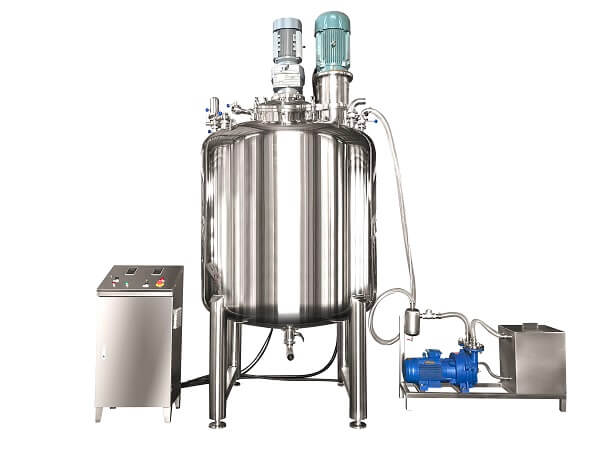
For large batches, a jacketed vacuum emulsifier with a bottom or side high-shear head handles both dispersion and homogenization in one vessel. For very high throughput, some plants move to continuous inline mixers where oil and water phase are pumped through a rotor-stator head at a fixed rate — this trades batch flexibility for speed and reproducibility.
Why acid matters here
Vinegar or another food acid is dosed partly into the water phase and partly at the end of mixing. The finished pH is typically low enough to act as the product's main preservation barrier, so accurate, repeatable acid dosing is a food-safety control, not just a flavour step.
3. Mix under vacuum to keep air out
High-shear mixing naturally pulls air into the product. In mayonnaise that trapped air is not just a cosmetic problem — it creates a foamy headspace, makes the fill weight inconsistent, and can give the emulsion a lighter colour and a texture that changes during shelf life.
That is why production-scale emulsifiers mix under vacuum. The vessel is sealed and evacuated before and during homogenization, so air bubbles are removed at the moment they form rather than after the product has thickened. When you compare equipment, check the guaranteed vacuum level (around −0.09 MPa is typical for food emulsifiers) and confirm the shaft seals are suitable for food service.
4. Cool the emulsion and control final viscosity
Mechanical work adds heat, and mayonnaise must leave the mixer at a controlled temperature before filling. A jacketed vessel with chilled water circulation brings the batch down steadily; gentle slow-speed scraping of the vessel wall (with an anchor or scraper agitator) keeps the cooling uniform and prevents a cold skin from forming on the surface.
Viscosity is also managed at this stage. Mayonnaise is shear-thinning, so it flows more easily under pump pressure and thickens again once at rest. Lines are therefore designed to handle the product gently after emulsification — oversized pumps and low-speed transfer help preserve the structure the mixer just built.
5. Scale: from lab batches to a 2000 L line
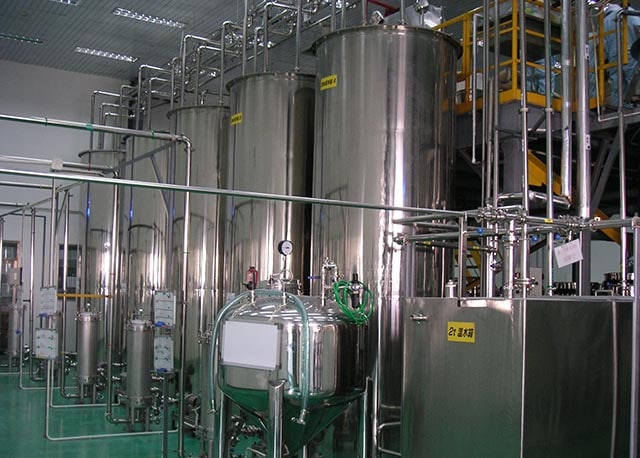
The same process runs at every scale, but the equipment differs:
- Lab (5–50 L): benchtop high-shear mixers for formulation work and shelf-life trials.
- Pilot (50–200 L): small vacuum emulsifier homogenizers that mirror production conditions closely enough to scale up predictably.
- Production (300–2000 L+): full vacuum emulsifier systems with heating, cooling, vacuum, and often a transfer pump to the filler.
If you are scaling up, the honest shortcut is to reproduce your lab process as closely as possible: same order of addition, same tip speed at the rotor-stator head, same vacuum level. A machine that cannot run under vacuum at production size will force you to reformulate — far more expensive than choosing the right vessel first.
The short version
Industrial mayonnaise is a controlled exercise in emulsion engineering: separate phase preparation, gradual oil addition under high shear, droplet-size control, vacuum deaeration, and gentle cooling. Get those steps right on equipment sized for your batch, and the product becomes repeatable — which is what a factory line is for.
FAQ about How Is Mayonnaise Made in a Factory: The Mixing Line Explained
Why is egg yolk used in industrial mayonnaise?
It contains lecithin, a natural emulsifier that coats the oil droplets and stops them merging back together. It is also the reason temperature control matters during the mix.
Why mix mayonnaise under vacuum?
High-shear mixing naturally pulls air into the product. In mayonnaise that trapped air creates a foamy headspace, makes fill weight inconsistent and shortens shelf life — so the vessel is sealed and evacuated before and during homogenization.
Why is the acid split between phases?
Vinegar or another food acid is dosed partly into the water phase and partly at the end of mixing; the finished pH is typically low enough to act as the product's main preservation barrier.
How do you scale a mayonnaise line from lab to 2000 L?
Reproduce the lab process as closely as possible: same order of addition, same tip speed at the rotor-stator head, same vacuum level.
Ask an engineer about your process
Four fields are all we need to come back with the right configuration. An engineer replies, not a sales bot.
Continue reading
How to Scale Cosmetic Cream Production from Lab to 2000L
Moving a formulation from a beaker to a full production vessel changes the physics of mixing — here is how to plan the scale-up without losing stability.
Read article → BUYING GUIDE · 2026-09-02Vacuum Emulsifier Buying Guide: RX, RS or RB Series
How to choose the right RX, RS or RB series — and the seven questions to answer before you request a quote.
Read article → PROCESS KNOWLEDGE · 2026-09-01High Shear Mixer vs Homogenizer: What's the Difference?
They look similar, they both emulsify — but they solve different problems.
Read article →Have a process question?
Send it to our engineers. We read every inquiry, and an engineer replies personally.
Ask an Engineer →