Home / Industries / Cosmetics & Personal Care / Serums & Active Treatments

Serum Mixers — Vitamin C, Hyaluronic Acid, Retinol

Process guidance, capacity range and machine recommendations for serums & active treatments.

Key Takeaways

  • Serums are low-viscosity and high-value: 100–5,000 cps, small batches, expensive actives.
  • The risk is not mixing — it is losing the active. Temperature, shear and oxygen exposure all matter more than cycle time.
  • Small batches mean the vessel-to-batch ratio is unforgiving; a machine sized for creams will not mix 50 L properly.
  • Vacuum protects oxygen-sensitive actives such as vitamin C as much as it removes air from the texture.
  • Lab and small production sizes in the same family let you develop and produce on identical geometry.

What you're making

Vitamin C serums, hyaluronic acid serums, retinol treatments, peptide complexes — these are typically low-viscosity aqueous or hydro-alcoholic systems with low-dose actives (0.5–10%).

Typical capacity: 50L — 500L
Typical viscosity: 100 – 5,000 cps

Serum Mixers — Vitamin C, Hyaluronic Acid, Retinol
PROCESS

How to make it on our machines

Dissolve actives in water/alcohol phase under slow agitation → add thickener → adjust pH carefully → deaerate under vacuum → sterile-filter → discharge. Avoid high-shear to preserve actives.

Small batches are less forgiving, not more

A serum batch of 50 to 500 L sounds easier than a cream batch of 1,000 L. It is not. The homogenizer has to be properly covered to work, and in a vessel that is too large for the batch the head runs partly in air — which shears foam instead of product and can actually damage shear-sensitive actives.

The practical rule is to size the machine to the batch you actually run, not to the largest batch you might one day run. If the range is genuinely wide, a small production machine plus a lab machine usually costs less than one oversized vessel that does both jobs badly.

Protecting the active

Vitamin C, retinoids, peptides and many botanical extracts are sensitive to heat, oxygen and sometimes shear. That is why the process for a serum is gentler than for a cream: disperse and emulsify at moderate shear, cool, and dose the actives at low temperature once the structure is set.

Vacuum helps twice here. It removes air during mixing, which limits oxidative loss, and it lets you draw powders into the batch without opening the vessel. Both matter more for a serum than for a cream, because the active is a larger share of the product's cost.

Develop and produce on the same geometry

Serum formulations are reformulated often, and every reformulation has to be re-validated. Running trials on an RS or RX lab machine and production on the same family keeps the homogenizer geometry consistent, which makes the transfer predictable instead of empirical.

This is also the cheapest way to test a new active: a 5 L trial costs a fraction of a 200 L trial, and if the trial machine shares the production machine's shear geometry, the result transfers.

RECOMMENDED MACHINES

Best-Sized Models for Serums & Active Treatments

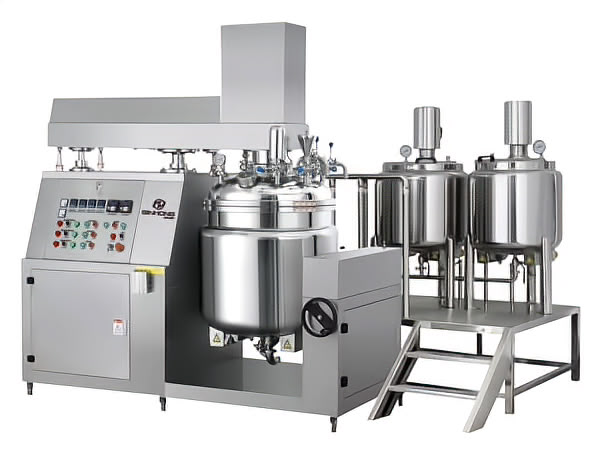
RS Vacuum Emulsifying Mixer

Best for: Face cream, body lotion and ointment — medium viscosity, light powder loading.

RS vacuum emulsifying mixer: top-entry homogenizer, in-vessel circulation, tilting vessel for easy discharge and cleaning. Built in SS316L contact parts, Ra ≤ 0…

View spec sheet →

RX Vacuum Homogenizer Mixer

Best for: Toothpaste, high-viscosity cream and ointment — heavier powder loading, finer particle size.

RX vacuum homogenizer mixer: bottom-entry homogenizer, external circulation loop, self-pumping. Built in SS316L contact parts, Ra ≤ 0.4 μm.…

View spec sheet →

FAQ about Serums & Active Treatments

Can I use a cream machine for serums?

You can, but only if the batch is large enough to cover the homogenizer properly. A 1,000 L vessel asked to mix 50 L will not do it well. If serums are a real part of your output, a smaller production machine or a lab machine from the same family is the better buy.

How do you avoid degrading vitamin C or retinol?

Dose them low and last — after homogenising and after most of the cooling, below about 40 °C — and mix under vacuum to limit oxygen exposure. Keeping the high-shear stage short also helps, since some actives are shear-sensitive as well as heat-sensitive.

Is high shear necessary at all for a serum?

Usually not at cream levels of intensity. Most serums need enough shear to disperse a thickener or to emulsify a small oil phase, not the prolonged homogenising a heavy cream requires. Running the homogenizer longer than necessary is a common way to thin a serum below its target viscosity.

What batch size makes sense?

Most serum production sits between 50 and 500 L. Work out how many units that represents at your fill size before choosing — serum batches are often smaller than people expect because the product is dosed in millilitres, not grams.

REQUEST A QUOTE

Ask an engineer about your process

Four fields are all we need to come back with the right configuration. An engineer replies, not a sales bot.

The product and the process decide the configuration — the more detail, the more useful our reply.

We never share your details. We never spam. Prefer email? [email protected]

Building a serum & active treatment line?

Tell us your batch size, viscosity and target capacity. We'll recommend the right machine from our production lineup and quote it.

Get a Quote →