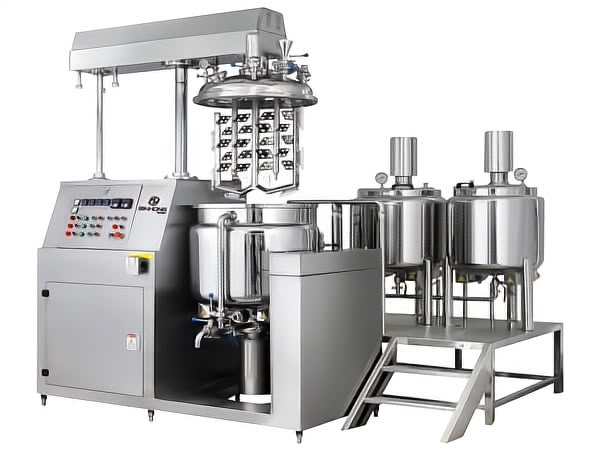
Process guidance, capacity range and machine recommendations for color cosmetics.
Liquid foundations, lip glosses, mascaras, concealers, eyeshadows — these contain pigments and colorants requiring uniform dispersion and batch-to-batch color consistency.
Typical capacity: 50L — 500L
Typical viscosity: 1,000 – 50,000 cps

Disperse pigments in oil phase under high-shear → mill if needed → combine with water/oil base → add actives and fragrance → deaerate → discharge.
Foundation, lip gloss, concealer and cream eyeshadow all depend on how finely and how uniformly the pigment is dispersed. Under-dispersed pigment gives a weaker, duller colour and a shade that drifts as the particles settle; over-dispersed pigment can shift the shade in the other direction. Consistency of dispersion energy is what keeps batches matching.
This is a different job from making a white cream. The oil phase has to wet the pigment before it can be sheared apart, and the powder loading is far higher — which is why circulation, not just shear, is the limiting factor.
A heavily loaded, viscous paste does not move by itself. In a top-entry layout the head shears what reaches it, and in a thick batch that may not be the whole vessel. RX avoids this by driving the product through an external loop so the entire batch passes the shear zone repeatedly; RB does the same with a separate emulsifying pump beside the tank.
Both approaches also make discharge easier, since a thick paste will not drain out of a fixed vessel by gravity. That matters on a colour line, where every kilogram left in the vessel is product you cannot sell and residue you must clean.
On a plant running dozens of shades, changeover time is production time. Contact surfaces polished to Ra ≤ 0.4 µm release pigment far more readily than a rougher finish, and a vessel that empties completely leaves less to clean in the first place.
Plan for this when you specify the machine. A slightly smaller vessel that cleans in twenty minutes will out-produce a larger one that takes an hour between shades, however impressive the larger machine looks on a spec sheet.
Best for: Face cream, body lotion and ointment — medium viscosity, light powder loading.
RS vacuum emulsifying mixer: top-entry homogenizer, in-vessel circulation, tilting vessel for easy discharge and cleaning. Built in SS316L contact parts, Ra ≤ 0…
View spec sheet →Best for: Toothpaste, high-viscosity cream and ointment — heavier powder loading, finer particle size.
RX vacuum homogenizer mixer: bottom-entry homogenizer, external circulation loop, self-pumping. Built in SS316L contact parts, Ra ≤ 0.4 μm.…
View spec sheet →Often yes, if it is specified for the harder of the two jobs. Colour work is heavier: higher solids, higher viscosity, more abrasive. If colour is a meaningful share of output, specify for colour — an RX with its circulation loop — and run the lighter creams on it without difficulty.
Most often because dispersion energy varied — different homogenising time, different temperature, or powder added at a different rate. Fix the parameters rather than adjusting the pigment load: record homogenising time and temperature and hold them constant, and the shade will follow.
Expect wear and plan maintenance. Pigments are harder than the steel they run against and will polish surfaces and wear scraper blades over time. SS316L contact parts polished to Ra ≤ 0.4 µm handle this well, but scrapers and seals should be on a scheduled inspection.
Most colour work runs 50–500 L. Because changeovers are frequent and shades are numerous, throughput usually improves with a smaller vessel that cleans fast rather than a large one that ties up a shift per changeover.

Four fields are all we need to come back with the right configuration. An engineer replies, not a sales bot.
Tell us your batch size, viscosity and target capacity. We'll recommend the right machine from our production lineup and quote it.
Get a Quote →