Home / Industries / Cosmetics & Personal Care / Hair Care Products

Hair Care Mixers — Shampoo, Conditioner, Hair Mask

Process guidance, capacity range and machine recommendations for hair care products.

Key Takeaways

  • Shampoo, conditioner and hair mask sit at very different viscosities — 500 to 30,000 cps — so the same line often needs the range rather than one product.
  • Surfactant systems foam aggressively. Vacuum is what keeps the batch from turning into a foam tank during homogenising.
  • Powder wet-out is the slow step in many hair products: salts, polymers and cationic surfactants have to be drawn in without forming fish-eyes.
  • Conditioners and masks are cationic and behave like creams; shampoos are low-viscosity liquids and discharge easily.
  • Cleaning between formulations matters more here than almost anywhere else — a machine that empties and rinses fast is worth more than one with extra capacity.

What you're making

Shampoos, conditioners, hair masks, hair dyes, styling gels — these are surfactant-based liquid products requiring gentle mixing for foaming control and powder wet-out for thickeners.

Typical capacity: 100L — 2000L
Typical viscosity: 500 – 30,000 cps

Hair Care Mixers — Shampoo, Conditioner, Hair Mask
PROCESS

How to make it on our machines

Dissolve surfactants in water under slow agitation → add thickeners (carbomer, xanthan) under high-shear → neutralize → add actives and fragrance → deaerate.

Three products, three very different rheologies

A shampoo is a thin surfactant solution, often a few hundred to a few thousand centipoise. A conditioner is closer to a cream. A hair mask can be heavier than either. Putting all three on one machine means the machine has to be comfortable across the whole band, which is why this application spans RS, RX and RB rather than one layout.

The low end is easy — anything circulates. The high end is what decides the purchase: a thick mask with powder loading needs an external circulation loop, which is RX's territory, or a separate emulsifying pump, which is RB's.

Foam is the practical enemy

Surfactant-based products want to foam, and high-shear mixing gives them every opportunity. Once a batch has foamed, you cannot fill it accurately, and breaking the foam down afterwards usually means waiting or adding an antifoam you did not want in the formula.

Mixing under vacuum at −0.09 MPa removes the foam as it forms instead of after the fact. It also means you can pull powders in through the vacuum line rather than dumping them into an open vessel, which is both faster and cleaner.

Powder wet-out and cleaning

Salts, polymers and conditioning agents are the slow part of most hair-care batches. Drawn in too fast they form agglomerates that no amount of subsequent shearing will fully break down; drawn in under vacuum into a well-sheared vortex they incorporate cleanly. This is where a scraped-wall agitator working against a high-shear head pays off.

Between batches, the machine has to be clean enough that yesterday's cationic conditioner does not end up in today's anionic shampoo. A tilting vessel, which RS provides, and contact surfaces polished to Ra ≤ 0.4 µm, which all three layouts provide, make that significantly quicker than a fixed vessel with a rougher finish.

RECOMMENDED MACHINES

Best-Sized Models for Hair Care Products

RB Vacuum Emulsifier Mixer

Best for: High-viscosity cream, ointment and toothpaste — especially where ceiling height is limited.

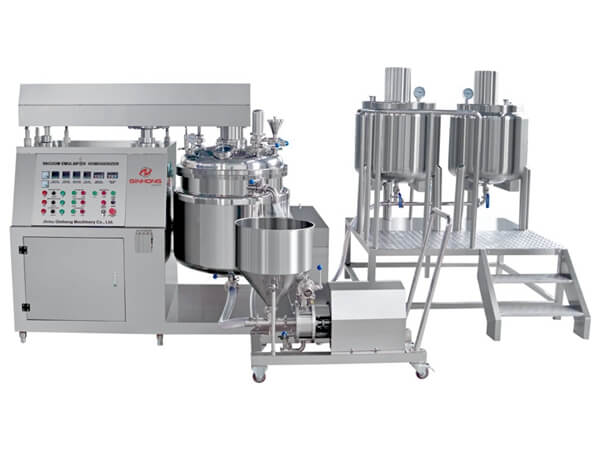
RB vacuum emulsifier mixer: an independent emulsifying pump piped to the vessel bottom, external circulation. Ideal when headroom is tight, and easier to servic…

View spec sheet →

RS Vacuum Emulsifying Mixer

Best for: Face cream, body lotion and ointment — medium viscosity, light powder loading.

RS vacuum emulsifying mixer: top-entry homogenizer, in-vessel circulation, tilting vessel for easy discharge and cleaning. Built in SS316L contact parts, Ra ≤ 0…

View spec sheet →

RX Vacuum Homogenizer Mixer

Best for: Toothpaste, high-viscosity cream and ointment — heavier powder loading, finer particle size.

RX vacuum homogenizer mixer: bottom-entry homogenizer, external circulation loop, self-pumping. Built in SS316L contact parts, Ra ≤ 0.4 μm.…

View spec sheet →

FAQ about Hair Care Products

One machine for shampoo and hair mask?

It depends where in the viscosity range you spend most of your time. Shampoo alone runs happily on an RS. If hair masks or heavy conditioners are a meaningful share of your output, RX's external circulation loop or RB's separate emulsifying pump will handle the thick end far better.

How do you stop surfactant batches from foaming?

Mix under vacuum. Foam is air dispersed in liquid, and removing the air as it is generated is far more effective than trying to collapse the foam afterwards. Vacuum also lets you draw powders directly into the batch rather than charging them through an open manhole.

Can powders be added without forming lumps?

Yes, and the method matters more than the machine: add them slowly into a well-formed vortex, preferably under vacuum through the suction line, with the high-shear head running. Dumping a whole bag onto the surface is what creates fish-eyes.

Is SS316L necessary for hair care?

It is what we build contact parts from as standard, polished to Ra ≤ 0.4 µm. Beyond corrosion resistance, the polish is what makes cleaning between formulations quick — and on a plant running several different surfactant systems, cleaning time is real production time.

REQUEST A QUOTE

Ask an engineer about your process

Four fields are all we need to come back with the right configuration. An engineer replies, not a sales bot.

The product and the process decide the configuration — the more detail, the more useful our reply.

We never share your details. We never spam. Prefer email? [email protected]

Building a hair care product line?

Tell us your batch size, viscosity and target capacity. We'll recommend the right machine from our production lineup and quote it.

Get a Quote →