Home / Industries / Cosmetics & Personal Care / Sun Care & Sunscreens

Sunscreen & Sun Care Mixers

Process guidance, capacity range and machine recommendations for sun care & sunscreens.

Key Takeaways

  • Sunscreen is a suspension as much as an emulsion: mineral UV filters are solids that have to stay dispersed, not dissolved.
  • Dispersion quality directly determines the SPF you actually get — poorly dispersed filters give less protection than the formula claims.
  • Zinc oxide and titanium dioxide are abrasive. Contact surfaces and seal choices matter more here than in a plain cream.
  • Most sunscreens are water-in-oil, so they sit at the heavier end of the cosmetic range and need good circulation.
  • Batch sizes are usually smaller than for body care — 100 to 1,000 L — because formulations are numerous and reformulated often.

What you're making

Sunscreen lotions, after-sun products, self-tanners, sun oils — these contain organic UV filters (avobenzone, octinoxate) that require careful temperature control and uniform dispersion.

Typical capacity: 100L — 1000L
Typical viscosity: 5,000 – 30,000 cps

Sunscreen & Sun Care Mixers
PROCESS

How to make it on our machines

Heat oil phase with UV filters → combine with water phase at controlled temperature (60–70°C) under vacuum and high-shear → cool → add fragrance → discharge. Avoid air incorporation that oxidizes UV filters.

The hard part is the mineral filter

Unlike a chemical UV absorber, zinc oxide and titanium dioxide do not dissolve — they are fine solids held in suspension. That changes the job from emulsifying to dispersing: the powder has to be wetted out, de-agglomerated and then kept from settling while the batch cools and structures.

Under-dispersed filter is the common failure. It shows up as an SPF below what the formulation was designed for, a whitening that will not go away on rubbing in, and in the worst case a gritty feel. High shear under vacuum, run long enough to de-agglomerate rather than merely to mix, is the fix.

Water-in-oil and the circulation problem

Most sunscreens are water-in-oil, which puts them at the heavier end of the cosmetic viscosity range. A heavy batch around a top-entry homogenizer can stall — the head shears what reaches it but does not pull the whole vessel contents through.

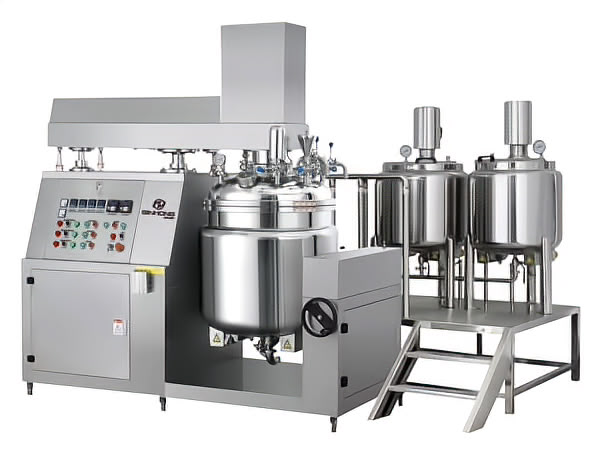
RX addresses this directly: the homogenizer enters from the bottom and drives the product through an external circulation loop, so the entire batch passes through the shear zone rather than only what happens to drift into it. For plants with limited headroom, RB achieves the same circulation with the emulsifying pump standing beside the vessel.

Abrasion and cleaning

Mineral filters are hard particles. Over time they polish and wear whatever they are dragged across, which makes surface finish and seal selection more consequential on a sunscreen line than on a lotion line. Contact parts in SS316L polished to Ra ≤ 0.4 µm both resist this and clean down faster afterwards.

Because sunscreen formulations are numerous and get reformulated as regulations change, cleaning between batches is a recurring cost rather than an occasional one. A vessel that empties completely and rinses quickly is worth more here than extra litres of capacity.

RECOMMENDED MACHINES

Best-Sized Models for Sun Care & Sunscreens

RS Vacuum Emulsifying Mixer

Best for: Face cream, body lotion and ointment — medium viscosity, light powder loading.

RS vacuum emulsifying mixer: top-entry homogenizer, in-vessel circulation, tilting vessel for easy discharge and cleaning. Built in SS316L contact parts, Ra ≤ 0…

View spec sheet →

RX Vacuum Homogenizer Mixer

Best for: Toothpaste, high-viscosity cream and ointment — heavier powder loading, finer particle size.

RX vacuum homogenizer mixer: bottom-entry homogenizer, external circulation loop, self-pumping. Built in SS316L contact parts, Ra ≤ 0.4 μm.…

View spec sheet →

FAQ about Sun Care & Sunscreens

Can a vacuum emulsifier disperse mineral sunscreen filters?

Yes — this is one of the jobs it is built for. The combination of high shear and vacuum wets the powder out, breaks the agglomerates down and removes the air that would otherwise be trapped around the particles. What matters is running the dispersion stage long enough; mixing until the batch looks uniform is not the same as de-agglomerating it.

Why is my SPF lower than the formulation should give?

The most common cause is incomplete dispersion of the mineral filter. If the particles are still agglomerated, they do not deliver the protection the formula was calculated for. Increasing dispersion time and shear, not increasing filter loading, is usually the right correction.

RS or RX for sunscreen?

For most water-in-oil sunscreens, RX. Its bottom-entry homogenizer and external circulation loop move a heavy batch that would otherwise stall around a top-entry head. RS is fine for lighter sunscreen lotions and for lab trials; RB is the answer when ceiling height prevents either.

Does the mineral content damage the machine?

Mineral filters are abrasive and will wear surfaces over time. That is one reason contact parts are SS316L polished to Ra ≤ 0.4 µm, and why seal and scraper condition should be on your maintenance schedule. It is normal wear, not a defect — but it should be planned for.

REQUEST A QUOTE

Ask an engineer about your process

Four fields are all we need to come back with the right configuration. An engineer replies, not a sales bot.

The product and the process decide the configuration — the more detail, the more useful our reply.

We never share your details. We never spam. Prefer email? [email protected]

Building a sun care & sunscreen line?

Tell us your batch size, viscosity and target capacity. We'll recommend the right machine from our production lineup and quote it.

Get a Quote →