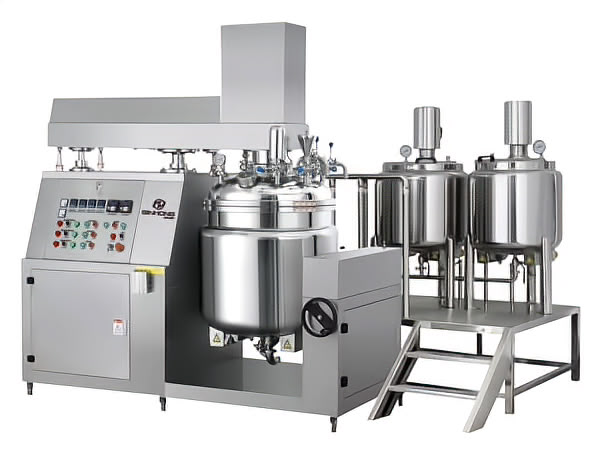
Process guidance, capacity range and machine recommendations for face creams & moisturizers.
Day creams, night creams, anti-aging creams, BB/CC creams, foundation — these are oil-in-water (O/W) or water-in-oil (W/O) emulsions where droplet size, uniformity and air content determine the final feel on skin.
Typical capacity: 1L (lab) — 2000L (production)
Typical viscosity: 5,000 – 50,000 cps typical

Heat oil and water phases separately → combine under high-shear homogenization at 70–80°C → cool under vacuum while continuing agitation → add actives and fragrance at low temperature → discharge.
Three failures account for most of the cream batches that get re-worked. The first is graininess: the waxes and butters in the oil phase crystallise at different temperatures, and if the cooling rate is not controlled the batch comes out sandy instead of smooth. A jacketed vessel with a scraped-wall agitator gives you a defined cooling curve instead of letting the batch sit and cool however it cools.
The second is air. High-shear homogenising is violent by design, and everything it does to the droplets it also does to the headspace — air gets folded in and stays there. Under vacuum at −0.09 MPa that air is pulled out as the batch is homogenised, which is why vacuum and homogenising belong on the same machine rather than in two separate steps.
The third is over-shearing. More homogenising time does keep reducing droplet size, but past a point the extra time costs you cycle time and can thin a structured cream below its target viscosity. The practical answer is to set homogenising time by trial at lab scale and then hold it constant in production.
RS is the general-purpose answer and the one most cream makers should start with. Its homogenizer enters from the top and emulsifies inside the vessel, and the vessel tilts to discharge — which makes both emptying and cleaning straightforward. It suits medium-viscosity products with light powder loading, which is exactly the profile of a day cream, night cream or BB cream.
RX earns its place when the formulation gets heavier. Its homogenizer enters from the bottom and circulates the product through an external loop, so it keeps moving high-viscosity and high-solid batches that would otherwise stall around a top-entry head. It also discharges through the homogenizer itself, which suits water-in-oil creams and formulations with more powder in them.
If headroom is the constraint rather than viscosity, RB is the third layout: the emulsifying pump stands beside the tank as a separate unit instead of above or below it. It is also the easiest of the three to service.
Scale-up is where most cream launches lose time. A formulation that works beautifully at 5 L can come out of a 500 L vessel with a different texture, because the power input per litre and the cooling rate are both different. Running the first trials on a lab machine from the same family — RS or RX in lab size — keeps the geometry of the homogenizer consistent and makes the jump far more predictable.
What transfers is the process, not the rpm. Hold tip speed and homogenising time constant between scales rather than copying the speed setting, and expect the cooling stage to take longer on a bigger vessel because the surface-to-volume ratio works against you.
Best for: Face cream, body lotion and ointment — medium viscosity, light powder loading.
RS vacuum emulsifying mixer: top-entry homogenizer, in-vessel circulation, tilting vessel for easy discharge and cleaning. Built in SS316L contact parts, Ra ≤ 0…
View spec sheet →Best for: Toothpaste, high-viscosity cream and ointment — heavier powder loading, finer particle size.
RX vacuum homogenizer mixer: bottom-entry homogenizer, external circulation loop, self-pumping. Built in SS316L contact parts, Ra ≤ 0.4 μm.…
View spec sheet →Yes. The vessel does not care which phase is continuous — what changes is the order you add the phases and where you run the homogenizer. RS handles both comfortably at the viscosities typical of face creams; for heavier water-in-oil formulations with more powder loading, RX circulates the batch better.
For any cream you intend to sell, yes. Homogenising pulls air into the batch, and that air shows up as pinholes on the surface, a shorter shelf life and oxidation of the oil phase. Vacuum at −0.09 MPa removes it during the same step rather than as a separate de-aerating operation.
Below about 40 °C, after homogenising and after most of the cooling. Vitamin C, retinol and most preservatives degrade if they go in hot. This is why the cooling stage happens in the same vessel — you dose the actives and then finish cooling under gentle agitation.
Work backwards from your batch size and how many batches you want per shift, not from the largest machine in the budget. Remember that RS tops out at 2,000 L and RX at 5,000 L; a machine that is too large mixes a small batch badly because the homogenizer never gets properly covered.

Four fields are all we need to come back with the right configuration. An engineer replies, not a sales bot.
Tell us your batch size, viscosity and target capacity. We'll recommend the right machine from our production lineup and quote it.
Get a Quote →