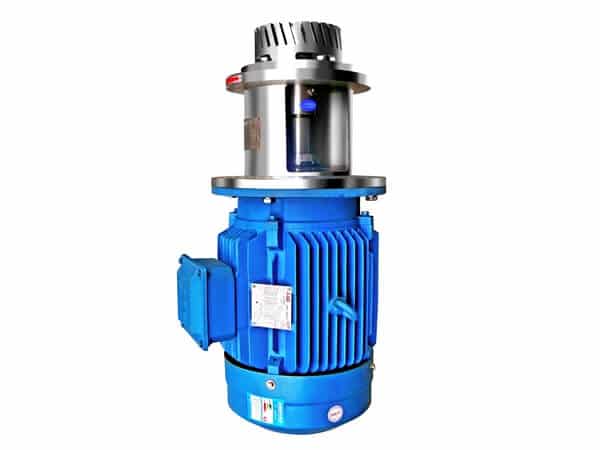
A rotor-stator homogenizer mounted through the bottom of the vessel, with the head working inside the tank and no external circulation loop. The usual arrangement is angled into the tank bottom; it can also be mounted vertically, and the larger sizes — the heaviest machines in the range — are built to go in vertical. It relates to the RX the same way the JX relates to the RS — the difference from the RX is that the DX does not circulate product outside the tank.
Best for: In-tank emulsifying when a top entry is impractical — limited headroom, or a closed vessel.

Real footage shot by our own team — no voiceover, no subtitles. Want to see a particular step, or a size closer to yours? Ask us and we will send that clip.
Watch this video on YouTube — hosted on YouTube, so it needs YouTube access. If it will not play in your country, ask us and we will send you the file directly.
The DX mounts to a flange on the bottom of the manufacturing tank — usually angled into the vessel. It can also go in vertically, and the bigger the machine the heavier it gets, so the larger sizes are built to mount vertically. Either way the head sits inside the tank: there is no external circulation loop and no pipework to run outside the vessel.
The rotor is driven by an ABB or Siemens motor and rotates at 3000 rpm, creating strong centrifugal force. Product is drawn into the high shear zone from the top of the rotor.
That centrifugal force drives the product into the narrow gap between rotor and stator, where it is pressed and crushed — dispersed, homogenized and emulsified. Along the tangent the rotor reaches a linear velocity of 15–40 m/s.
Product jets out through the openings in the stator and circulates inside the tank. After several passes it is completely high sheared, dispersed, emulsified and homogenized.
A batch (in-tank) machine. Every size below is a standard build — tell us your batch size or flow rate and we will quote the matching machine.
| Model | Motor power (kW) | Speed (rpm) | Handling capacity (L) |
|---|---|---|---|
| DX-2.2 | 2.2 | 3000 | 50~100 |
| DX-4 | 4 | 3000 | 100~200 |
| DX-7.5 | 7.5 | 3000 | 200~400 |
| DX-11 | 11 | 3000 | 300~500 |
| DX-15 | 15 | 3000 | 500~1000 |
| DX-22 | 22 | 3000 | 1000~2000 |
| DX-30 | 30 | 3000 | 1000~2000 |
| DX-37 | 37 | 3000 | 2000~2300 |
| DX-45 | 45 | 3000 | 2000~3000 |
| DX-55 | 55 | 3000 | 3000~4000 |
| DX-75 | 75 | 1500 | 3000~5000 |
Our DX documentation names the industries it is built for. Tell us your product and we will confirm the configuration.
Cosmetics & toiletries — viscous cream and emulsions
Pharmaceuticals — ointment and emulsion
Food — sauce, dressing and paste
Chemicals — emulsions and dispersions
Standard build is 380V / 50Hz / 3-phase with push-button control. Everything below is available on request.
CE marked. Our range is certified by Ente Certificazione Macchine (ECM), Italy, to the Machinery Directive 2006/42/EC and the Low Voltage Directive 2014/35/EU, against EN ISO 12100:2010 and EN 60204-1:2018 — certificate No. 3J260508.JGMDT35, valid to 07 May 2031.
The machine specification complies with cGMP requirements: product contact parts in SS316L, mirror polished so the machine cleans down between batches, with sanitary clamp connections on the pipework.
JX · ZX · SF · FS · All high shear mixers
Four fields are all we need to come back with the right configuration. An engineer replies, not a sales bot.