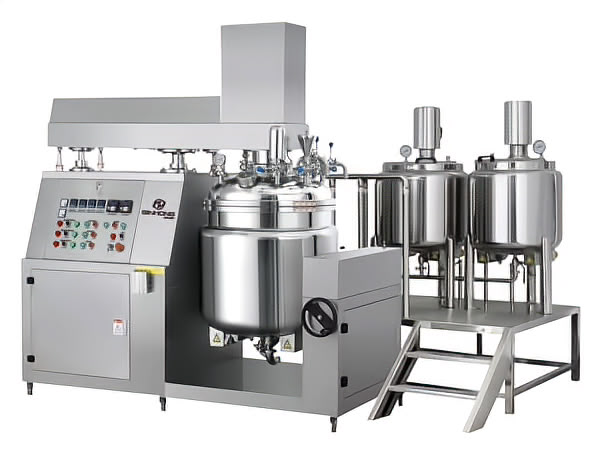
Process guidance, capacity range and machine recommendations for body lotions & after-sun.
Body lotions, hand creams, after-sun, baby care — these are lighter emulsions than face creams, typically water-in-oil or oil-in-water with lower viscosity and faster cycle times.
Typical capacity: 100L — 2000L
Typical viscosity: 1,000 – 10,000 cps

Heat phases → combine under vacuum with high-shear homogenizer → cool under continuous agitation → add fragrance and actives → discharge. Cycle time 2–4 hours typical.
A body lotion is a lighter emulsion than a face cream: less wax, less butter, more water. At 1,000–10,000 cps it flows readily, which means the agitator does not fight the batch and heat transfers faster through the jacket. In practice a full cycle — heat, combine, homogenise, cool, dose, discharge — lands in the two-to-four-hour range rather than the longer cycles heavier creams need.
The practical consequence is that throughput is usually limited by how many cycles you can run in a shift, not by how much the vessel holds. Two batches at 500 L often beat one at 1,000 L, because the heating and cooling stages dominate the cycle and they do not scale linearly with volume.
The difference between a lotion that feels elegant and one that feels watery is usually droplet size and cooling rate, not the formula. Homogenising under vacuum gives you small, uniform droplets; the subsequent cooling sets the structure. If cooling is left uncontrolled, the same formula can come out glossy one day and dull the next.
A wall scraper matters more than it looks. It keeps product moving across the heat-transfer surface instead of letting a stagnant layer insulate the batch, which is what makes cooling both faster and repeatable.
RS covers most of this ground. Its top-entry homogenizer emulsifies inside the vessel and the vessel tilts to discharge, so emptying a low-viscosity product is quick and cleaning between formulations is straightforward — which matters if you run several lotion variants on one machine.
RX becomes the better answer when the range extends into thicker products: body butters, high-solid after-sun, or anything with meaningful powder loading. Its bottom-entry homogenizer and external circulation loop keep heavy batches moving, and because it discharges through the homogenizer it also handles products that would otherwise need pumping out. RB is the alternative when ceiling height is the problem.
Whichever layout you choose, all three are built with SS316L contact parts polished to Ra ≤ 0.4 µm, and all three run the same water-ring vacuum at −0.09 MPa — so the process you develop transfers between them.
Best for: Face cream, body lotion and ointment — medium viscosity, light powder loading.
RS vacuum emulsifying mixer: top-entry homogenizer, in-vessel circulation, tilting vessel for easy discharge and cleaning. Built in SS316L contact parts, Ra ≤ 0…
View spec sheet →Best for: Toothpaste, high-viscosity cream and ointment — heavier powder loading, finer particle size.
RX vacuum homogenizer mixer: bottom-entry homogenizer, external circulation loop, self-pumping. Built in SS316L contact parts, Ra ≤ 0.4 μm.…
View spec sheet →Usually yes, but the machine has to be the right one. Body butter sits far higher in viscosity than a lotion and loads more powder, which is where RX's external circulation loop earns its keep. On an RS, a very heavy batch may not circulate well around the top-entry head.
Roughly two to four hours end to end for a typical formulation: heating the phases, combining and homogenising under vacuum, cooling under agitation, dosing fragrance and actives, then discharging. The cooling stage is usually the longest single step.
Yes, for any commercial lotion. Most formulations require the phases to be combined hot and then cooled in a controlled way to set the texture. Separate heating and cooling tanks would mean an extra transfer and an extra cleaning cycle.
Lab sizes exist in the same RS and RX families, which is what we recommend for formulation trials before committing to a production vessel. Developing on the lab machine in the same family makes the scale-up far more predictable than developing on a benchtop stirrer.

Four fields are all we need to come back with the right configuration. An engineer replies, not a sales bot.
Tell us your batch size, viscosity and target capacity. We'll recommend the right machine from our production lineup and quote it.
Get a Quote →