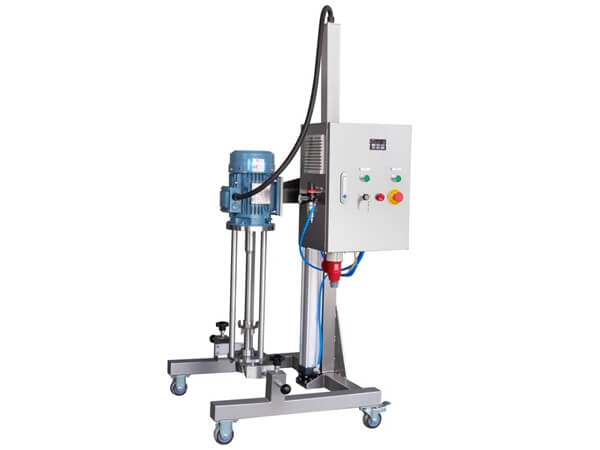
Work inside the tank: charge the vessel, run the cycle, discharge.
The homogenizer enters the vessel from the top and works inside the tank — the same principle as the homogenizer on our RS vacuum emulsifier. It is a batch machine: you charge the vessel, run the cycle and discharge.
Choose it when: Emulsifying and breaking down agglomerates inside a tank — including a tank you already own.
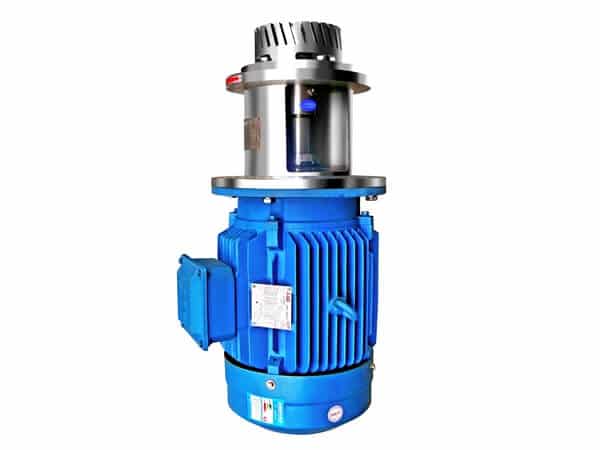
A rotor-stator homogenizer mounted through the bottom of the vessel, with the head working inside the tank and no external circulation loop. The usual arrangement is angled into the tank bottom; it can also be mounted vertically, and the larger sizes — the heaviest machines in the range — are built to go in vertical. It relates to the RX the same way the JX relates to the RS — the difference from the RX is that the DX does not circulate product outside the tank.
Choose it when: In-tank emulsifying when a top entry is impractical — limited headroom, or a closed vessel.
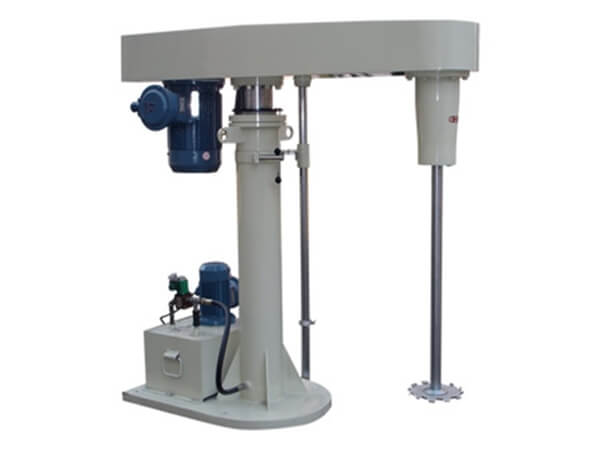
Similar to the JX in that it is a batch machine working inside the tank, but it runs a toothed dispersing disc instead of a rotor-stator head, and it runs at 1500 rpm rather than 3000 rpm. It is also the disperser we build into our multi-shaft mixers.
Choose it when: Wetting out powders and dispersing pigments in a tank — high flow, lower shear than a rotor-stator head.
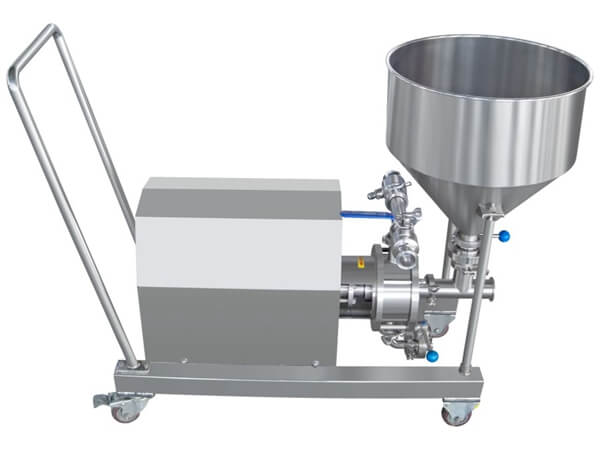
Work in the pipeline: product passes through continuously.
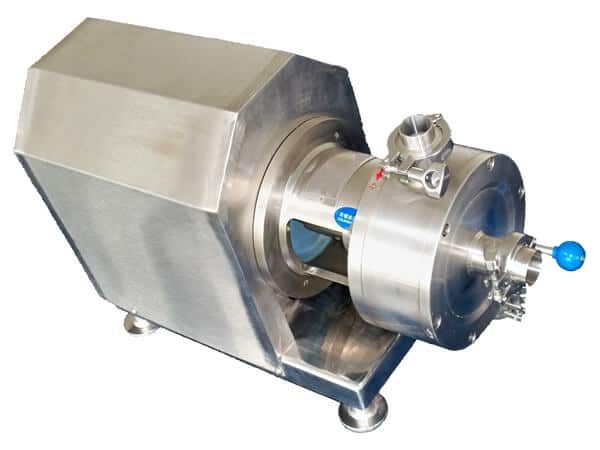
A pipeline machine: the ZX is installed in the pipework and product passes through it continuously. It is the same machine that sits at the heart of our RB vacuum emulsifier mixer, and it also works as the transfer pump.
Choose it when: Continuous production, or adding high shear to an existing line without changing the vessel.
An inline powder-liquid mixer developed from the ZX. It keeps the pipeline layout but uses fewer rotor-stator stages, a larger pumping capacity, and a guide auger ahead of the rotor to increase thrust — so it draws powder into the liquid stream far more aggressively.
Choose it when: Wetting powders into a liquid stream continuously — no lumps, and no dust around the operator.
| JX | DX | ZX | SF | FS | |
|---|---|---|---|---|---|
| Where it works | Top of the tank | Into the tank bottom — angled or vertical | In the pipeline | In the pipeline | Top of the tank |
| Batch or continuous | Batch | Batch | Continuous | Continuous | Batch |
| Workhead | Rotor-stator | Rotor-stator | Rotor-stator | Rotor-stator + guide auger | Toothed disc |
| Standard speed | 3000 rpm | 3000 rpm | 3000 rpm | 3000 rpm | 1500 rpm |
| Standard sizes | 0.37–75 kW | 2.2–75 kW | 2.2–75 kW | 7.5–22 kW | 0.37–75 kW |
| Rated by | Motor power | Motor power | Motor power + flow | Motor power + flow | Motor power |
| Lab sizes | Yes | No | No | No | Yes |
High shear describes the mechanism — a rotor turning at speed inside a stator, forcing product through a narrow gap. Homogenizer describes the result — droplets and particles broken down to a fine, uniform size. On a rotor-stator machine the two are the same machine, and the terms are used interchangeably in the trade. The one exception in our range is the FS: it uses a toothed dispersing disc rather than a rotor-stator, so we call it a disperser, not a homogenizer. Read the longer answer.
The 0.37 / 0.75 / 1 kW sizes are the same machines we list as lab mixers — useful for trialling a formulation before you commit to a production size. The lab heads run on 220V / 50Hz single phase.
CE marked. Our range is certified by Ente Certificazione Macchine (ECM), Italy, to the Machinery Directive 2006/42/EC and the Low Voltage Directive 2014/35/EU, against EN ISO 12100:2010 and EN 60204-1:2018 — certificate No. 3J260508.JGMDT35, valid to 07 May 2031.
Four fields are all we need to come back with the right configuration. An engineer replies, not a sales bot.