
Toothpaste looks like a simple product — powder and liquid stirred into a paste — until the first production batch comes out gritty, full of air, or thick enough to stall the filling pump. Most of those failures are mixing failures rather than formulation failures. Abrasive silica, a gum that swells, and a surfactant that foams are three awkward materials to run in the same vessel, and the mixing equipment has to cope with all three in one cycle. This article covers how toothpaste is actually mixed at production scale, what each family of formulation demands, and the specification points that decide whether the line runs cleanly for years.
Why toothpaste is harder to mix than it looks
Three properties make toothpaste awkward. It becomes very viscous as soon as the binder hydrates, far beyond what a standard open agitator will move. It carries a heavy load of abrasive solid — silica, calcium carbonate or dicalcium phosphate — that settles the moment agitation stops and wears anything it rubs against. And it contains surfactant, so any air left in the batch turns into foam that is very hard to remove later.
Then there is the product specification itself. Toothpaste has to leave the tube as a smooth ribbon, hold its shape on the brush, and stay that way for the whole shelf life. A batch that is aerated or only partly hydrated can look perfectly acceptable in the vessel and still fail at filling, or worse, fail three months later in the customer's bathroom.
- Abrasives settle and compact: without wall-scraping agitation the solids collect at the bottom, and the paste is inconsistent from the first tube to the last.
- Gums swell from the outside in: added too quickly they form hydrated shells around dry cores, and that is where grittiness comes from.
- Surfactant foams whenever air is present: foam is air you then have to remove, and a paste thick enough to trap it will not release it easily.
- Humectants make the batch sticky: sorbitol and glycerin raise viscosity and hold on to any moisture you would rather remove.
The four formula families and what each one demands
Toothpaste is regulated as a cosmetic in most markets, but it is not one product. The mixing problems differ enough between families that a line set up for one will struggle with another.
Opaque abrasive pastes
This is the standard family: an abrasive, sorbitol or glycerin as humectant, a cellulose or xanthan binder, plus fluoride and flavour. The mixing problem here is suspension rather than emulsification — the abrasive has to be wetted out and then held evenly in the gel structure. That takes enough low-speed torque to keep a very thick batch moving at the wall, and enough high-shear time to break up abrasive agglomerates.
Gel and translucent formulations
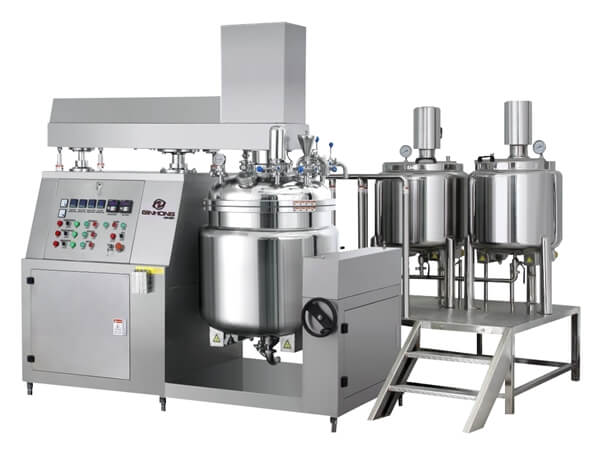
Clear and striped gels are far less forgiving. Any entrained air shows up as haze or as visible bubbles in the ribbon, and refractive-index matching between the abrasive and the liquid phase is part of the formulation — so unwetted silica or unhydrated thickener shows immediately as cloudiness. These batches are normally run in a closed vacuum vessel rather than an open one, and deaeration is a defined process step rather than a nice-to-have. Where clarity is the selling point, a vacuum emulsifier such as the RS series is often the better tool.
Whitening and peroxide formulas
Peroxide and high-abrasive whitening products add two constraints. Peroxide decomposes, so temperature control matters and unnecessary hot holding is paid for in lost active content. And a higher abrasive loading increases wear, which is an equipment question as much as a process one: contact parts should be specified for abrasion, not only for corrosion.
Herbal, charcoal and sensitive formulations
Activated charcoal, herbal extracts and high-glycerin sensitive formulas each change the rheology. Charcoal is light and dusty, so it prefers to float rather than wet in; herbal extracts can carry insoluble matter that needs dispersing. These are the formulations most likely to need a repeat trial at lab scale, because small changes in solids loading move the finished viscosity a long way.
What goes into the bowl, and in what order
Charge order is where most grittiness is created, and it is the cheapest thing on the line to fix. The principle is simple: hydrate the binder in the liquid phase before the abrasive goes in, and add every powder into a moving surface rather than onto a static one.
- Charge the humectant and water and start low-speed agitation.
- Add the binder slowly into the vortex, or pre-slurry it in a side vessel and meter it in. Give it a real hydration window before anything else goes in.
- Add sweetener, fluoride and any water-soluble actives, and confirm the solution is clear before moving on.
- Charge the abrasive in portions, under vacuum or through the powder inlet, letting each portion wet out before the next.
- Run the high-shear disperser for as long as the structure needs. Judge it by appearance and by a microscope or particle-size check, not by a fixed number of minutes copied from a lab sheet.
- Add surfactant and flavour last, at low shear. Both foam, and both are easier to lose to foam than to recover afterwards.
If you come from cream production, note the difference. In an emulsion the oil phase is dispersed into the water phase and the homogenizer does the real work; in toothpaste there is no oil phase to emulsify, so the disperser is doing deagglomeration while the binder does the structuring. Running the machine like a cream line tends to over-shear the surfactant and under-wet the abrasive. The distinction between the two tools is set out in high shear mixer vs homogenizer.
The mixing cycle on a multi-shaft mixer
Toothpaste is the classic application for a multi-shaft machine, because one vessel has to do jobs that a single agitator cannot do at the same time.
- The anchor, or sigma blade, turns slowly and sweeps the wall. It handles bulk movement of a very thick paste and, critically, keeps scraping the wall so heat transfers and solids do not dry on and bake.
- The high-speed disperser breaks up agglomerates and wets out powder. It does the work an emulsifying head would do in a cream, minus the emulsifying.
- The third shaft on an SZ series triple-shaft mixer adds a second disperser or an emulsifying head at a different position, which shortens the cycle on the thickest batches and gives more uniform shear through the vessel height.
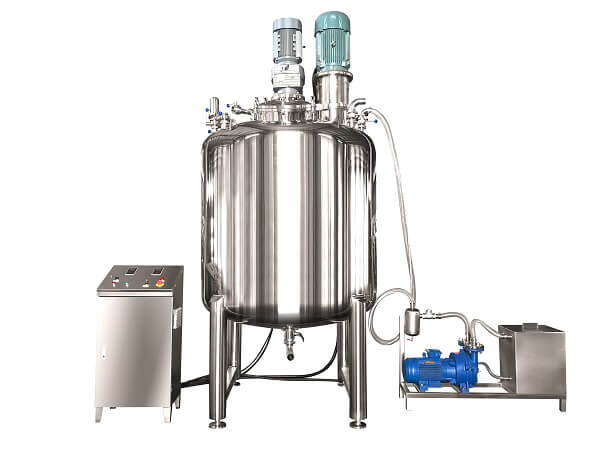
The practical benefit is cycle time. On a single-shaft machine you either shear the batch or you move it, and on a paste this thick you cannot interrupt one to do the other without losing temperature and time. Multi-shaft machines also normally come with a hydraulic or screw discharge, which matters more than it sounds — a batch this viscous will not find its own way out of a bottom valve.
Vacuum, and why it decides whether the tubes fill clean
Vacuum in toothpaste production is less about chemical stability than about the physical product. Air in the finished paste gives a dull ribbon, a tube that fills light by weight, and in the worst case a tube that swells on the shelf. The batch also foams at the filler, which slows the line down and puts air back in at the last possible moment.
- Pull vacuum before the high-shear stage, not after. Deaerating a finished paste is slow, because the structure already traps the bubbles.
- Charge powders through the powder inlet under vacuum, so you add product instead of a pocket of air with every portion.
- Keep the slow agitator below vortex speed until the vessel is properly loaded.
- Check the lid gasket and shaft seal first if vacuum will not hold. Mechanical leaks are much cheaper to fix than a reworked batch.
One caveat is worth stating. Vacuum also pulls volatiles, so flavour compounds and any alcohol in the flavour system will come off under sustained vacuum. The deaeration step should therefore be as short as the product allows. Depending on utilities and on how your flavour is dosed, this is often the point where a lab trial saves a production batch — and it is the same failure pattern covered in cream separation and aeration fixes.
From a lab batch to a production vessel
Scaling toothpaste is mostly about heat transfer and shear geometry. A 5 kg lab batch has a lot of surface area per kilogram and disperses in a couple of minutes; a 1000 kg batch has a fraction of that area and a much longer path from the wall to the centre. Scale by volume, keep the same mixing time, and you will under-mix the production batch.
- Match tip speed, not rpm. Disperser tip speed is what sets the shear the powder actually sees.
- Expect hydration to take longer at volume. Do not copy the lab hydration time; verify it.
- Budget more cooling time. Jacket area per litre falls as the vessel grows, so the cooling ramp that took twenty minutes in the lab may take an hour.
- Watch solids loading. Abrasive that stays suspended in a beaker can settle in a large vessel between the end of mixing and the start of discharge.
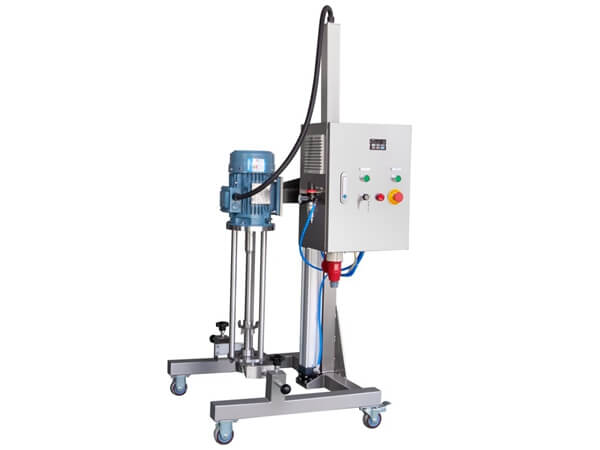
A lab machine such as the JX series is worth using for exactly this reason: you can reproduce the charge order, the hydration window and the vacuum step at five or twenty litres and see which one actually drives the result, before you commit a full vessel. It is also the cheapest place to discover that a formulation is sensitive to shear. The same scale-up logic, applied to creams, is covered in scaling cosmetic cream production.
What to specify before you request a quote
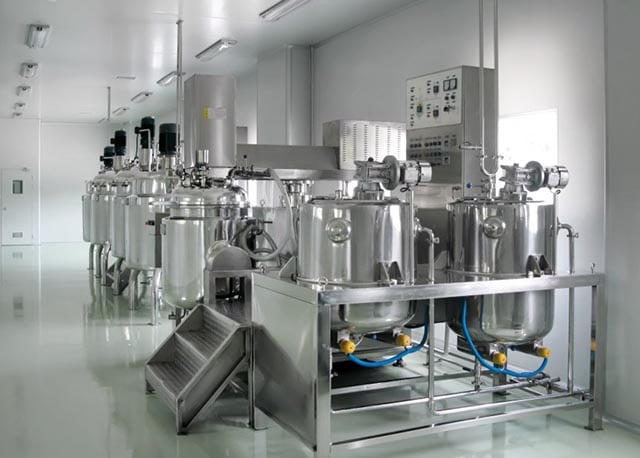
Toothpaste lines are bought once and run for years, and the decisions that matter are mostly about cleanability, wear and vacuum rather than about motor power.
- Contact parts in SS316L, mirror-polished to Ra <= 0.4 um. Abrasive paste polishes a rough surface and then holds product in it.
- No dead corners — full CIP readiness. Dried toothpaste is difficult to remove, and carryover between batches is a common source of grit in the first batch of the day.
- A vacuum rating stated as a number, with a pump sized to reach and hold it — not simply "vacuum available".
- Jacketed heating and cooling with enough area for your cycle time, plus a temperature probe in the product rather than only in the jacket.
- Discharge matched to a paste. On a large machine a bottom valve on its own will not move a batch this thick.
- Variable speed on both agitator and disperser, so you can shear during hydration and then back off before the surfactant foams.
- ISO 22716 cosmetics GMP-ready design and CE certified, with
EN 10204 3.1mill certificates for the contact parts if you need material traceability.
The bottom line
Toothpaste is a suspension problem, not an emulsion problem: the job is to wet out an abrasive, hydrate a binder without creating grit, and get the air out before the batch sets. That is why slow wall-scraping agitation and a high-speed disperser belong in the same vessel, and why vacuum sits early in the cycle rather than at the end. Most production failures trace back to charge order, hydration time or a deaeration step that ran too late — all far cheaper to find on a lab mixer than in a full vessel. Specify contact surfaces, vacuum rating and discharge for an abrasive paste rather than for a liquid, and the machine will still be running the same formulations years from now.
Continue reading
Cream Separating? Vacuum Emulsifier Problems and Practical Fixes
Separation, bubbles, grit, drifting viscosity: the defects that ruin a cream batch, and the vacuum emulsifier checks that fix each one.
Read article → COMPLIANCE · 2026-09-15GMP Vacuum Emulsifier Design: What to Specify for Pharma
What to lock down on a pharmaceutical vacuum emulsifier - surface finish, CIP, documentation and controls - before you sign the quote.
Read article → MACHINE COMPARISON · 2026-09-12RS vs RX vs RB Vacuum Emulsifier: Which One for Your Batch Size
Three vacuum emulsifier series, three different jobs — here’s how to pick the right one without over- or under-sizing your line.
Read article →Have a process question?
Send it to our engineers. We read every inquiry, and an engineer replies personally.
Ask an Engineer →