
High-viscosity food pastes - peanut butter, chocolate spread, filling creams, tahini, tomato concentrate, dough - behave nothing like the liquids most mixer sizing rules were written for. They do not splash, they do not wet the whole wall, and a propeller that would blend a 500 cP sauce in minutes will simply carve a hole in a 500,000 cP paste and rotate inside it forever. Buying a planetary mixer for this duty comes down to four decisions: working volume, blade geometry, whether you need heat and vacuum, and how the batch is going to get out of the vessel. This guide walks through each one in the order a supplier will ask you about them, with the numbers that actually move the quote.
What counts as "high-viscosity" in a food plant
There is no single threshold, but in practice you are in paste territory once the material holds its shape on a spatula, or once you have to scrape it off the wall rather than pour it out. Peanut butter typically sits in the 100,000-250,000 cP range depending on temperature and grind fineness; chocolate and hazelnut spreads are in the same neighbourhood; tahini, tomato concentrate and fruit pastes vary widely with solids content and temperature; dough is non-Newtonian and better described by yield stress than by a single viscosity number.
Two consequences matter more than the number itself. First, most of these products are shear-thinning or shear-thickening to some degree, so the viscosity you measure on the bench is not the viscosity the motor sees at every point of the cycle. Second, the worst case for the drive is almost never mid-batch - it is cold start, when the material is at its stiffest and the whole batch is at rest. Size the motor and the gearbox for that moment, not for the average.
A quick field test: if the material levels out on its own within a few seconds after mixing stops, a high-shear mixer or a standard agitator will probably handle it. If it stays where you left it, you want planetary action.
How planetary mixing actually moves the batch
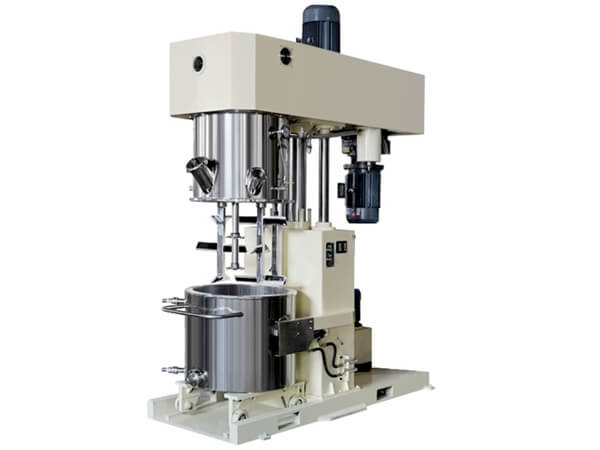
In a planetary mixer the blade rotates on its own axis while that axis itself orbits the centre of the vessel - hence "planetary". The two speeds are usually independent, which is what lets you run high orbital speed with low blade speed, or the reverse, for different phases of the same recipe.
The reason this works on pastes is the wall. A conventional agitator in a thick paste creates a cavity and the material outside that cavity simply sits there. Planetary blades carry scrapers that run against the vessel wall, continuously peeling material off and folding it back into the centre. There is no vortex, no dead ring at the wall, and - because the tip speed stays low - the shear is gentle enough that you do not wreck the structure of a product that depends on it.
This is also why planetary mixing is the usual answer for heat transfer. On a thick paste, heat moves through the wall mostly by conduction, and conduction only works while fresh material keeps arriving at the surface. The scrapers are doing thermal work, not just mixing work.
Size by working volume, not by vessel volume
This is the single most common way to buy the wrong machine. A model described as "1000 L" describes the geometric volume of the vessel, not how much paste you can actually process in it. For thick, aerated or high-solids products, usable working volume is commonly somewhere in the 40-70% band - and the honest number depends on your formulation, not on the brochure.
Work backwards from the batch you ship. If you need 500 kg of peanut butter per batch at roughly 1.05 kg/L, that is about 476 L of product, which means you are shopping for a vessel in the 700-1000 L class rather than a 500 L one. Ask the supplier for the guaranteed working volume and the corresponding batch weight at your viscosity - in writing, on the quotation.
Two allowances are worth building in. If the process aerates the product - whipping, creaming, any step that deliberately folds air in - size for the aerated volume, not the charged volume. And if there is any chance the product line grows, moving one size up at purchase time is far cheaper than replacing the machine three years later.
Tooling: the blade decides what you can make
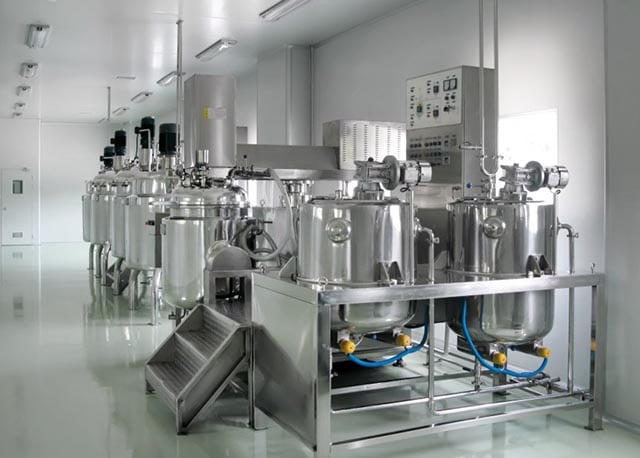
Most plants do not need a different mixer for each product - they need the right set of blades. The four configurations that cover nearly all food paste duty:
- Frame or gate with scrapers - the workhorse for thick pastes. Runs close to the wall with food-grade scraper blades, and handles mixing and heat transfer together.
- Twisted or sigma-style blades - heavier kneading action, used for dough and very high-solids masses where you need folding rather than smearing.
- Planetary plus high-speed disperser - a second, faster shaft that lets you wet out powders and then mix down in the same vessel, removing a transfer step.
- Emulsifying head (optional) - for reducing particle size in the same vessel. Check the viscosity ceiling; these lose effectiveness as the batch thickens.
Two purchasing details get missed. Ask how long a blade change takes and whether it needs special tooling - that number directly sets your changeover time between SKUs. And treat the scrapers as the consumable they are: confirm the material is food-grade, that the profile is stocked, and what the lead time is. A machine waiting on a scraper is a machine down.
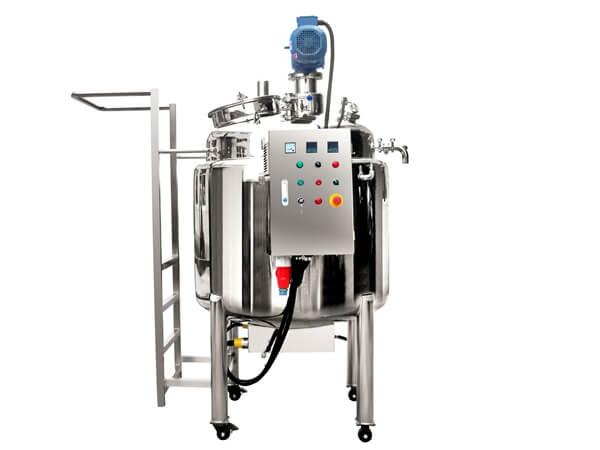
For lines that run a filler directly off the mixer, it is also worth looking at mixing tanks and vessels as buffer or holding stages - they are often the cheapest way to decouple mixing from packaging.
Heat, vacuum and discharge - the three build questions
Heating and cooling
A jacket is standard; the questions are area and medium. Ask for the actual heat-transfer area in square metres, and for measured heat-up and cool-down times on a comparable product rather than a calculated estimate. Thick pastes are slow, and on products where temperature drives viscosity - chocolate, spreads, anything with a melting fat phase - this often sets your batch time more than the mixing itself does.
Vacuum
Vacuum is used for deaeration before filling, and for dust control during powder charging. Air left in a paste shows up as pinholes in the finished pack and as oxidation during storage. The level you need depends on the product and the packaging line, so specify the outcome you want rather than a number copied from another plant, and confirm the pump and seal arrangement can hold it for the full cycle.
Discharge
This is where paste projects most often stall, and it should be designed backwards from the packer. Three common arrangements:
- Bottom ball or piston valve - clean, complete emptying; works when the product will still flow under its own weight while warm.
- Discharge screw - the usual answer for material that will not flow at all; the screw pushes it out and often feeds the filler directly.
- Tilting or lowering vessel - common on smaller multi-SKU plants, mostly because it makes cleaning and inspection easy.
Whichever you pick, lock down outlet height, connection type and discharge rate at the same time as the mixer. Retrofitting any of those after the machine is installed is expensive.
Materials, finishes and cleanability
For food contact the specification is not exotic, but it needs to be explicit:
- SS316L contact parts, mirror-polished Ra ≤ 0.4 µm - ask which surfaces are covered; frame welds and blade roots are sometimes excluded by default.
- No dead corners - full CIP readiness - ground welds on the product side, no exposed threads in the product zone.
- EN 10204 3.1 mill certificates for contact steel, so the material is traceable at audit.
- CE certified - confirm the declaration covers the machine as supplied, including any optional shaft or jacketing.
- Food-grade shaft sealing - the shaft seal is the hardest point to clean; ask whether it is CIP-able and whether it comes apart without tools.
On sugar- and protein-containing pastes, inspection usually concentrates on three places: the scraper holders, the blade roots, and the discharge valve cavity. Those are where residue survives a normal rinse. If the product includes alcohol-based flavours, or if you charge dry powders that generate dust, ask about ATEX-compatible construction - zone classification is available on request, and it is far cheaper to build in than to add later.
What to ask a supplier before you accept a quote
- Guaranteed working volume and batch weight at your viscosity - not the model number.
- Measured mixing time and motor load curve at that viscosity, including cold-start conditions.
- Jacket heat-transfer area and measured heat-up / cool-down times on a comparable product.
- Discharge method, outlet height, connection type and discharge rate - matched to your filling line.
- Material certificates (EN 10204 3.1) and a surface-finish report for contact parts.
- Spare parts list with lead times - scrapers and seals are the parts you will actually order.
- Whether a factory acceptance test can be run on your own material, at your batch size.
That last one is the one worth pushing for. On high-viscosity duty, paper specifications match far more often than machines do: a blade whose profile is slightly wrong, a scraper gap a millimetre loose, or a jacket short on area will all look fine on a datasheet and will all show up within ten minutes of running real product. A factory acceptance test on your own material settles it in an afternoon.
The bottom line
Four things decide whether a planetary mixer works out: size it by working volume rather than vessel volume; choose the tooling for the products you actually run; settle heating, vacuum and discharge together with the machine so it connects cleanly to your line; and specify the contact surfaces and cleanability in enough detail to pass an audit.
If you take one step from this guide, make it this: send your material, batch size and packaging method to two or three suppliers and ask for a trial on your own product. That answers in a week what a month of comparing datasheets will not. Our planetary mixer range and the food industry applications pages give you the starting point; the number that matters always comes from a trial.
Continue reading
Toothpaste Manufacturing: Mixing Equipment for Every Formula
Abrasives, gums and foaming surfactant in one vessel: how toothpaste is mixed at production scale, and what to specify on the machine.
Read article → TROUBLESHOOTING · 2026-09-22Cream Separating? Vacuum Emulsifier Problems and Practical Fixes
Separation, bubbles, grit, drifting viscosity: the defects that ruin a cream batch, and the vacuum emulsifier checks that fix each one.
Read article → COMPLIANCE · 2026-09-15GMP Vacuum Emulsifier Design: What to Specify for Pharma
What to lock down on a pharmaceutical vacuum emulsifier - surface finish, CIP, documentation and controls - before you sign the quote.
Read article →Have a process question?
Send it to our engineers. We read every inquiry, and an engineer replies personally.
Ask an Engineer →