
Key Takeaways
- Lipstick color problems - weak shade, streaks, grit - usually start in dispersion rather than in the pigment.
- Dispersion has three separate jobs: wetting the pigment surface, breaking the agglomerates, and keeping the particles from flocculating again.
- A high-shear head disperses well in a low-viscosity premix but cavitates, entrains air and overheats a thick pigment paste.
- A planetary mixer turns, homogenises and de-aerates a high-solids paste evenly, but hard agglomerates still need a pre-dispersion step.
- Grind gauge readings, color measurement and a first-piece check are the only reliable proof that a batch is dispersed.
A lipstick batch that looked right in the lab can reach the filling line reading thin, streaky, or slightly gritty. The first reaction is usually to blame the pigment or ask for a stronger color. In most cases the pigment is behaving exactly as its particle size says it will, and the batch is telling you the dispersion step did not finish. Color cosmetics are unforgiving in this respect: a cream can hide a small dispersion fault behind opacity and fragrance, while a lipstick shows it on the bullet under a shop light.
Why dispersion, not the pigment, decides the batch
A pigment is not a dye. It does not dissolve into the oil phase. It stays as solid particles that have to be separated from one another and coated by the carrier, and what arrives in the drum is not individual particles but agglomerates - clusters held together by surface forces and often by a film of air or moisture.
Dispersion is the work of breaking those clusters down and keeping them apart. It splits into three jobs, and each one fails in a different way.
- Wetting: the carrier has to displace air and moisture from the pigment surface. Poor wetting leaves dry pockets that later read as specks or weak color.
- De-agglomeration: mechanical stress has to open the clusters to the target size. Not enough stress leaves grit and streaks.
- Stabilisation: once separated, the particles must not flocculate back together during cooling, storage or pouring. This is where dispersants and the wax system earn their place.
A batch can pass the first job and fail the second, which is why “we mixed it for an hour” proves nothing. The only proof is a grind reading and a color measurement taken from a representative sample.
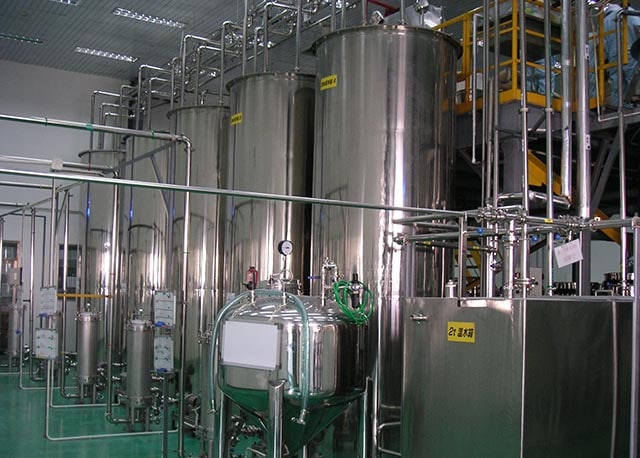
Wetting and de-agglomeration: two jobs, two failure modes
These two are often treated as one problem because both are answered with “more mixing”. They are not the same, and pushing harder on the wrong one makes the batch worse.
Wetting is a contact problem
Wetting depends on the carrier, the temperature and the order of addition more than on rotor speed. A pigment dropped into a hot wax phase that is already thick tends to be coated by wax before the oil has reached the surface, and the result is a batch that looks uniform but reads weak. Pre-wetting the pigment in part of the oil phase, at a temperature where the oil is mobile but the wax has not fully structured, gives the carrier a chance to displace the air film first.
Vacuum helps here for a physical reason. Air trapped inside the clusters expands and leaves more readily under reduced pressure, and a batch that is de-aerated wets more evenly. It does not replace a dispersant, but it removes one of the reasons the dispersant has to work so hard.
De-agglomeration needs stress where the pigment is
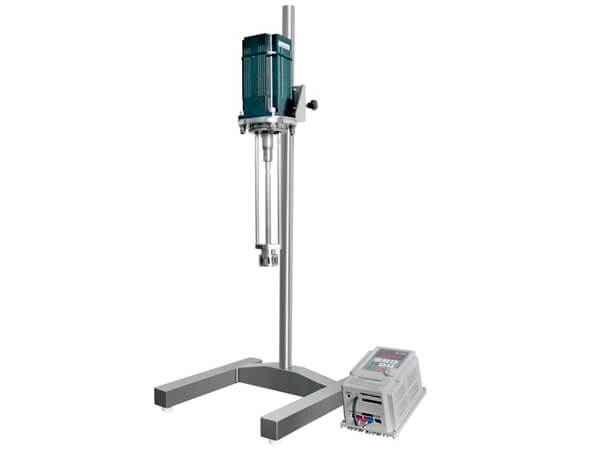
Breaking an agglomerate requires stress at the particle cluster, not flow in the bulk. In a low-viscosity liquid, a rotor-stator head delivers that stress in the gap, and the batch passes through the gap often enough to do the job. In a pigment paste the viscosity is high, the flow near the wall is poor, and much of the head’s energy turns into heat in a small volume instead of stress on the clusters.
This is where more speed stops helping. A high-shear head run in a thick paste can cavitate, pull air down the shaft and heat a narrow band of product while the bulk of the batch never passes through the working gap. The batch then has a dispersed layer near the head and untouched clusters elsewhere, which is exactly the streaky result the operator was trying to avoid.
Why a planetary mixer suits pigment paste
A planetary mixer approaches the problem from the other direction. Instead of forcing the product through a narrow gap, it moves two blades through the whole batch on a slow, high-torque orbit, with a scraper arm keeping the wall and the bottom clear. The product is turned over rather than pumped, so a high-solids paste that will not flow to a rotor still gets worked everywhere in the vessel.
For color cosmetics that behavior matters for three reasons:
- The batch stays homogeneous. Pigment that settles, or hangs on the wall, is pigment that shows up later as a shade difference between the top and the bottom of the pot.
- Heat is spread out. A slow blade puts less energy into a small volume, so there is less risk of overheating the wax phase or driving off the light fraction of the carrier.
- The vessel can be closed and put under vacuum. De-aeration is part of dispersion in a lipstick, not an optional extra, because trapped air shows as pits and dull patches on the bullet.
Ginhong builds planetary mixers in the PD, PX and YJ families, sized from pilot batches to production volumes, with the scraper, jacket and vacuum arrangement chosen per product. The same platform is used for high-viscosity pastes outside color cosmetics, which is a useful sanity check: if a machine is specified for a pigment paste, judge it on how it handles solids loading and heat, not on its headline speed.
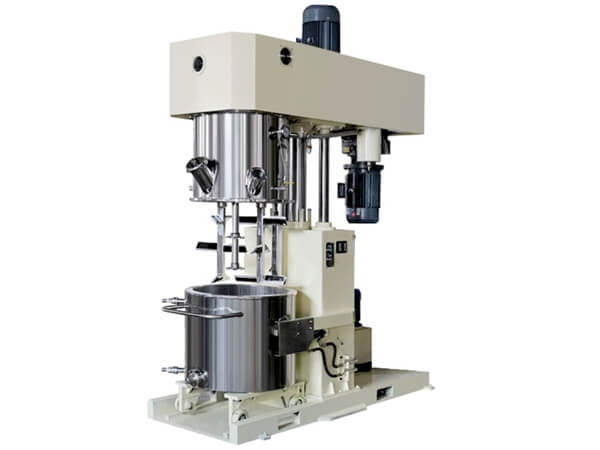
It is worth being honest about the limit. A planetary mixer is a turning and kneading machine, not a high-shear disperser. For a pigment that is hard to wet, or a formula with a high load of a fine organic colorant, the planetary stage is usually preceded by a pre-dispersion step - a high-speed disperser, a bead mill, or a high-shear head in a lower-viscosity premix. The planetary mixer then homogenises, de-aerates and holds the batch at temperature. Trying to do all of the de-agglomeration on the planetary blade alone is slow and often incomplete.
Where the machine sits in a lipstick line
A typical color-cosmetics line runs in a sequence, and the mixer’s job is defined by where it sits.
- Melt the wax and oil phase in a jacketed vessel, with agitation that keeps the temperature even and avoids local overheating at the jacket wall.
- Pre-wet and pre-disperse the pigments in part of the oil phase, or in a separate premix, before the wax structure sets.
- Transfer the premix into the planetary vessel and disperse under vacuum at a controlled temperature.
- Cool under slow agitation to the pouring temperature, keeping the pigment suspended so it does not settle or stratify.
- Discharge, filter and pour, with a sample taken before the pour for grind and color checks.
The order is not arbitrary. Adding pigment after the wax has structured, or cooling too fast without agitation, produces the same defects as a badly dispersed batch even when the dispersion itself was fine.
Sizing the batch and the vessel
Planetary mixers are usually specified by working volume rather than gross volume, because a paste needs freeboard to turn over. Loading a vessel close to its brim leaves no room for the blade to move product and is a common cause of uneven batches. The PX range covers pilot and mid-production sizes, and the YJ ram design is aimed at pastes that are too stiff to discharge by gravity.
For development work, a lab planetary mixer such as the PX-lab or a JX lab mixer lets a formulator reproduce the production blade geometry at small scale. That matters more than it sounds: a lab result from a different mixing principle often does not scale, and the discrepancy is discovered at the worst possible moment.
Settings that move the result more than rpm
Once the machine is right, the batch is won or lost on a handful of settings that are easy to treat as fixed.
- Order of addition: pigment into oil before wax, not into a structured wax phase. The carrier has to reach the particle surface first.
- Temperature window: hot enough for the carrier to wet and flow, cool enough that volatile fractions and heat-sensitive colorants are not damaged. The window is narrower than most process sheets admit.
- Loading level: too full and the blade cannot turn the batch over; too empty and the scraper misses the wall. Both show up as shade variation between batches.
- Vacuum and time: de-aeration needs time at temperature, not just a vacuum reading. Pulling vacuum for two minutes at the end of a cycle is not the same as dispersing under vacuum.
- Scraper clearance: a scraper that no longer touches the wall leaves a ring of unmixed product that enters the next batch as contamination or as a color shift.
None of these require a bigger motor. Most of them require a process sheet that says what the operator is actually trying to achieve at each step.
How to prove the batch is dispersed
The expensive way to find a dispersion fault is to find it on a finished bullet. The cheap way is to measure before the pour.
- Grind gauge: a drawdown on a fineness-of-grind gauge shows the largest surviving clusters. Take it from the top, middle and bottom of the vessel, not from one dip.
- Color measurement: a spectrophotometer reading against a retained standard catches shade drift that the eye accepts as normal variation.
- Microscopy: a quick slide under a light microscope shows whether clusters are still present and whether they are wetted or dry.
- First-piece check: pour a small bullet or a drawdown and inspect it under raking light before the whole batch is committed.
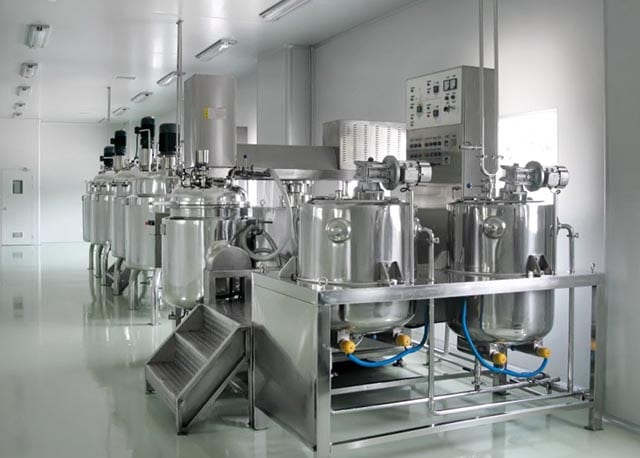
Cleaning belongs in the same discipline. Between shades, a scraper arm that can be lifted and inspected, a vessel with no dead corners and full CIP readiness, and a defined flush sequence do more for changeover time than any amount of extra flushing. Ginhong vessels are built with SS316L contact parts, mirror-polished to Ra <= 0.4 um, and an ISO 22716 cosmetics GMP-ready design, which is the baseline a color line should ask for before it asks for a price. For the wider comparison between mixing principles, see high-shear versus planetary.
The bottom line
Lipstick color problems are usually dispersion problems, and dispersion is three jobs: wetting, de-agglomeration and stabilisation. A high-shear head is good at the second job in a low-viscosity premix but poor at it in a thick paste, where it tends to cavitate, entrain air and heat a narrow band of product. A planetary mixer is the right machine for turning, homogenising and de-aerating a high-solids pigment paste, provided the hard agglomerates were opened in a pre-dispersion step. Specify the vessel around loading level, temperature control, vacuum and cleanability rather than headline speed, and prove every batch with a grind gauge and a color reading before the pour.
FAQ about Lipstick Pigment Dispersion: How to Get Even Color Without Grit
Can I disperse lipstick pigments in a high-shear mixer instead of a planetary mixer?
A high-shear head works well in a low-viscosity premix, where the batch passes through the rotor-stator gap often enough to break agglomerates. In a thick pigment paste it tends to cavitate, pull in air and heat a narrow band of product while the bulk stays untouched. Most color lines use a high-shear or bead-mill pre-dispersion followed by a planetary mixer for homogenising, de-aeration and temperature hold.
What grind fineness should a lipstick batch reach?
The target belongs to the formula and the shade, and most color cosmetics specify a fineness in the low-micron range measured on a grind gauge. Set the internal limit from your own retained standard, and check top, middle and bottom samples rather than a single dip.
Why does a lipstick look streaky after pouring?
Streaks usually mean the pigment was not fully wetted or de-agglomerated, or that the batch was cooled too fast without enough agitation and the pigment stratified. Check the grind reading and the pour temperature before changing the pigment supplier.
Does a planetary mixer need vacuum for color cosmetics?
Vacuum removes entrapped air, which otherwise shows as pits and dull patches on the bullet. Whether it is essential depends on the formula and the finish you need, but on a high-gloss lipstick it is usually specified.
How do you clean a planetary mixer between shades?
Lift and inspect the scraper, use a vessel with no dead corners and full CIP readiness, and define a flush sequence with a first-piece check. SS316L contact parts polished to Ra <= 0.4 um make the cleaning step shorter and more repeatable.
Ask an engineer about your process
Four fields are all we need to come back with the right configuration. An engineer replies, not a sales bot.
Continue reading
High-Shear Mixer Problems: Foaming, Lumps, and Seal Leaks
Most high-shear mixer problems come down to air, undispersed powder, or the shaft seal. How to tell which one you have, and what to change.
Read article → COMPLIANCE · 2026-10-20ATEX Mixing Equipment for Alcohol-Based Cosmetics: What to Specify
Alcohol-based formulas put the mixer inside a classified zone. What changes on the equipment, and where a vacuum emulsifier stops working.
Read article → MACHINE COMPARISON · 2026-10-13High Shear Mixer vs Planetary Mixer: Which One for Your Product
The line between a high-shear mixer and a planetary mixer is viscosity - how to tell which side your product sits on, and what guessing wrong costs.
Read article →Have a process question?
Send it to our engineers. We read every inquiry, and an engineer replies personally.
Ask an Engineer →