
Key Takeaways
- Ethanol has a flash point of about 13 °C and isopropyl alcohol about 12 °C — both well below any normal factory temperature, so the hazard exists without any heating.
- Zone classification is the plant operator's decision (1999/92/EC in the EU and the equivalent national rules elsewhere) — not the machine builder's call.
- A standard vacuum emulsifier is usually the wrong starting point: pulling vacuum on an ethanol batch boils solvent out of the formula and sends the vapour through a pump that may not be rated for it.
- Write the Ex markings, earthing, surface temperature, seal materials and vent path into the quotation request — a quote that says “ATEX” without a certificate number is not an answer.
A perfume, an aftershave, a facial toner, a hand sanitiser, a nail product - the moment a formula carries a serious share of ethanol or isopropyl alcohol, the mixing vessel stops being a process choice and becomes a piece of explosion-protection equipment. The awkward part is that this rarely comes up during formulation. It comes up when the plant safety file is written, or when an inspector asks for the zone drawing and the Ex certificates - and by then the vessel is usually already ordered, built and shipped. This article covers what actually changes on an alcohol line, what to write into the specification, and where a standard vacuum emulsifier quietly stops being the right machine.
Why alcohol changes the equipment, not just the label
The physical reason is simple: ethanol has a flash point of about 13 °C and isopropyl alcohol about 12 °C, both well below any normal factory temperature. A flammable liquid with a flash point that low does not need to be heated to produce a flammable atmosphere - it produces one while sitting still. Above the liquid surface, the vapour concentration passes through the flammable range (roughly 3.3 to 19 percent by volume for ethanol) at ordinary room temperature. An empty vessel that has just been drained, or a vessel being charged, is the worst case, because the headspace is full of vapour and there is plenty of air to go with it.
- It happens cold: most process hazards need heat to appear. This one is present at 20 °C, which is why the risk assessment cannot be deferred to the heating stage.
- The vapour is heavier than air: ethanol vapour is about 1.6 times the density of air, so it does not disperse upwards out of a vent - it collects in low points, floor drains, pits and cable trays. A leak at the bottom outlet is more serious than a leak at the lid.
- The liquid is a static generator: alcohol is a poor conductor, so splash filling, free-falling liquid and high-velocity flow all build charge that has nowhere to go. This is a filling and transfer problem as much as a mixing problem.
- Powders make it worse: charging a thickener or an active into a vessel that already holds solvent vapour can create a hybrid mixture - a dust cloud inside a flammable atmosphere - which is a harder case than either hazard on its own.

Which zone your mixer lands in, and who decides
Zone classification is not the machine builder's call. Under the workplace directive (1999/92/EC in the EU, and the equivalent national rules elsewhere), the plant operator classifies the hazardous area and documents it in an explosion protection document. The equipment supplier then has to supply hardware that matches the zone you declared, and prove it with certification. Buyers who expect the supplier to declare their zone end up either over-specified or unusable.
- Zone 0 - flammable atmosphere present continuously or for long periods. Equipment category 1G. Rarely declared inside a normally closed mixing vessel, but it happens on continuous process lines.
- Zone 1 - likely to occur occasionally in normal operation. Category 2G. This is the usual classification for the vapour space inside a closed vessel that is opened for charging, and for the immediate area around the lid, seals and sampling point.
- Zone 2 - not expected in normal operation, and if it occurs, only briefly. Category 3G. Often applied to the surrounding room where the vessel is closed and vented.
The design decision that moves cost more than anything else in the quote is closed versus open. A vessel with a sealing lid, a dedicated vent path and no routine open charging is a contained source, and the zone stays local to the machine. An open-top tank, or a vessel that has to be opened to add powder every batch, makes the vessel mouth a continuous release point and pulls the surrounding room into the assessment - which then brings in the electrical installation, the lighting, the forklift and the operator's shoes.
Two markings matter on every Ex component. The gas group, where ethanol and most common solvents fall into group IIA, and the temperature class, where ethanol's autoignition temperature of around 363 °C puts it in class T2 - meaning no exposed surface above 300 °C. In practice a motor marked for IIB T4 covers both with margin, but the marking has to cover the gas group and temperature class of the actual blend, not just the main solvent. Perfume oils, esters and fixatives can shift the assessment.
Where a standard vacuum emulsifier stops working
A vacuum emulsifier is the default answer for cosmetic cream, and most buyers reasonably assume it is the default answer for anything cosmetic. With a high alcohol load it is usually the wrong machine, and the reason is the vacuum itself. Ethanol at 20 °C has a vapour pressure of roughly 6 kPa, so pulling a vessel down to a few tens of millibar will boil ethanol at room temperature. Three things follow, none of them good.
- The solvent is stripped out of the batch. A formula specified at 70 percent ethanol does not arrive at the filler at 70 percent, and the loss is not repeatable from batch to batch.
- The vapour has to go somewhere. It travels through the vacuum pump, and an oil-sealed or liquid-ring pump that is not rated for solvent service becomes both a wear item and a potential ignition source downstream of the vessel.
- Everything that penetrates the vessel wall - the agitator shaft seal, the sight glass, the instrument ports - is now a boundary between a zone 1 interior and the room, and each one needs a documented solution.
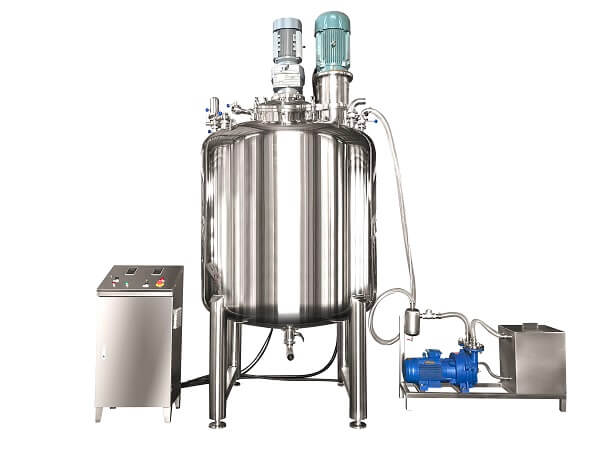
What works instead is a closed, jacketed vessel with a vent path, not a vacuum vessel. A slow sweep agitator handles blending and heat transfer in a thin batch; a high-shear head mounted through the lid handles dispersion of gums, actives and colour. The vapour goes to a condenser or a recovery system sized for the worst-case fill rate, and if the assessment calls for inerting, the vessel is nitrogen blanketed to hold oxygen below the limiting concentration for the solvent in use - around 10 percent by volume for ethanol, though the figure should come from your own safety assessment rather than from an article.
- Toners, colognes, sanitiser sprays - low viscosity, no structure to build: a closed tank with a high-shear head and a slow sweep is the efficient answer.
- Clear carbomer gels and gel sanitisers - the batch gets thick and needs wall contact: a double-shaft LZ or a planetary unit does the dispersion and the sweep in one vessel.
- Dilution, hold and transfer stages - a CG mixing or storage vessel, closed and vented, covers the steps that do not need shear at all.
- Genuine emulsions with a low alcohol load - a cream carrying a few percent alcohol is still an emulsion, and the RS or RX series remains the right platform, with a solvent-rated vacuum package rather than a standard one.
The specification items that decide whether it passes
Explosion protection is one of the few areas where a single missing line in a purchase specification can make an otherwise good machine impossible to commission. State these explicitly rather than leaving them to the standard build.
- Ex motor and electrical marking - gas group and temperature class stated on the order, with the certificate number appearing on the nameplate, not only in the brochure.
- Earthing and bonding - every metallic part bonded to a common earth, with a continuity test recorded at factory acceptance. Anti-static or conductive hoses and gaskets on every flexible connection, because an insulating hose between two earthed parts defeats the bonding.
- Surface temperature, including the jacket - the temperature class governs the hottest surface that can contact vapour, and a heating jacket or a steam line is often hotter than the product. Insulation is part of the protection, not a finish.
- Seals, sight glasses and wetted non-metals - a solvent-rated elastomer or PTFE, laminated safety glass rather than a plain disc, and no aluminium or magnesium components in the zone where impact or friction could spark.
- Instrumentation - level, temperature and pressure devices as intrinsically safe loops, with the barrier or isolator listed as part of the supply. A standard transmitter screwed into a zone 1 port undoes the rest of the package.
- Interlocks - the agitator must not start with the lid open, heating must not run without level coverage, and where inerting is used, the nitrogen purge has to be proven before solvent charging is enabled.
- Charging method - solvent pumped in below the liquid surface to limit static generation, powder charged under nitrogen where a hybrid mixture is possible. This is a piping and procedure item, but it belongs in the equipment specification because it decides where the ports go.
- Vent path - sized for the worst-case fill rate, routed to a safe location or to recovery, with a flame arrestor where the assessment requires one.
Materials, seals and cleaning in solvent service
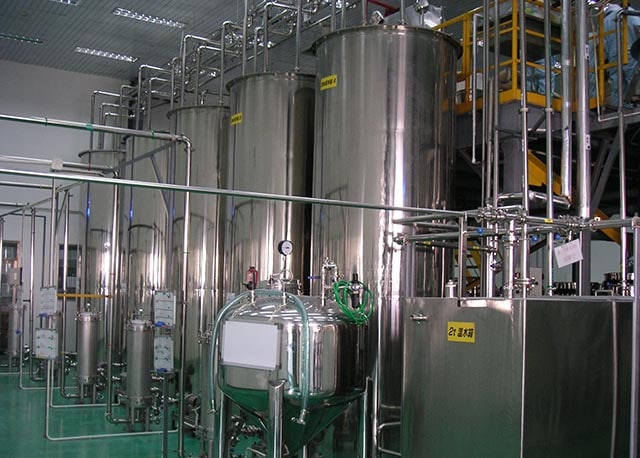
Stainless steel contact parts, mirror-polished to Ra ≤ 0.4 µm, is the normal specification and it still applies here, but for a slightly different reason. Alcohol formulas leave gum, perfume oils and fixatives that a plain water CIP does not dissolve, so the cleaning procedure needs a solvent stage of its own - and that stage is itself a flammable activity inside the same zone.
- Seal compatibility with the whole blend - ethanol alone is manageable for most common elastomers, but esters, ketones and fragrance components in the same formula can attack a seal that was approved for the main solvent. Ask for compatibility against the finished formula, not the headline ingredient.
- No dead corners - full CIP readiness matters more in solvent service, not less: a trapped residue in a dead corner is a permanent fuel source inside the vessel.
- Drainability - the vessel should empty by gravity with no pooled pocket, because a pool of alcohol in a sump is exactly the low point where heavier-than-air vapour collects.
- Documented gasket and hose list - so the materials can be reviewed when the formula changes.
What documentation to ask for
Compliance on an alcohol line is bought in documents as much as in steel. A quote that answers "yes, ATEX" without a certificate number is not an answer - the number is the whole point. List these as deliverables in the purchase order.
- CE marking and the EU declaration of conformity, covering both the machinery directive and 2014/34/EU for the explosion-protected parts.
- EU-type examination certificates for each Ex component, with numbers that match the nameplate on the delivered machine.
- An ignition hazard assessment or zone drawing for the machine as supplied, so your own explosion protection document can reference it.
- EN 10204 3.1 mill certificates for the product-contact steel, traceable to the vessel.
- The instruction manual with the specific ATEX safety instructions - temperature limits, permitted operating range, and what must be checked before each start-up.
- A spare parts list that identifies which parts are Ex-rated, because replacing a seal or a sight glass with the standard version silently removes the certification.
One more decision sits outside the machine: the electrical installation in the room. A fully certified mixer can still fail inspection on the cable gland or the junction box beside it. ATEX-compatible construction and zone classification are available on request on our vessels, and it is far cheaper to build in than to retrofit - but the boundary between machine and installation is where these projects most often stall. If your product is a genuine emulsion rather than a solvent blend, the specification work is different; we covered that in GMP vacuum emulsifier design for pharma, and the machine-level comparison in high shear mixer vs planetary mixer.
The bottom line
A high-alcohol formula changes the machine, not just the label. The hazard exists at room temperature, the vapour collects at floor level rather than dispersing, and the liquid generates static as it is charged - so the vessel has to be closed, vented, bonded and built from Ex-rated components, not simply cleaned to a high standard.
A standard vacuum emulsifier is usually the wrong starting point for these products, because pulling vacuum on an ethanol batch boils the solvent out of the formula and sends the vapour through a pump that may not be rated for it. A closed jacketed tank with a high-shear head, or a double-shaft unit where the batch thickens, is normally the better answer.
Classify the zone first - that is the plant operator's job, not the supplier's - then write the Ex markings, earthing, surface temperature, seal materials, instrumentation and vent path into the quotation request, and ask for certificate numbers rather than assurances. If a supplier cannot produce the numbers, the machine is not ready to be ordered.
FAQ about ATEX Mixing Equipment for Alcohol-Based Cosmetics: What to Specify
Who decides whether a mixer has to be ATEX-rated?
The plant operator classifies the hazardous area and documents it in an explosion protection document — under 1999/92/EC in the EU and the equivalent national rules elsewhere. The machine is then built for the zone the operator has declared.
Why not just use the standard vacuum emulsifier?
Because vacuum boils the ethanol out of the batch and pulls the vapour through a pump that may not be rated for it. A closed, jacketed vessel with a vent path, a slow sweep agitator and a high-shear head through the lid is the usual answer instead.
Which Ex markings apply to ethanol?
Gas group IIA, and temperature class T2 — ethanol's autoignition temperature is around 363 °C. Both markings matter on every Ex component.
What should the purchase order list as deliverables?
The certificate number for each Ex component, earthing and bonding provisions, maximum surface temperature, seal materials, instrumentation and the vent path. Note that a fully certified mixer can still fail inspection on the cable gland or junction box beside it.
Ask an engineer about your process
Four fields are all we need to come back with the right configuration. An engineer replies, not a sales bot.
Continue reading
High Shear Mixer vs Planetary Mixer: Which One for Your Product
The line between a high-shear mixer and a planetary mixer is viscosity - how to tell which side your product sits on, and what guessing wrong costs.
Read article → BUYING GUIDE · 2026-10-06Planetary Mixer Buying Guide for High-Viscosity Food Pastes
How to size a planetary mixer for peanut butter, chocolate spread and filling creams - working volume, blade choice, heating, vacuum and discharge.
Read article → INDUSTRY APPLICATION · 2026-09-29Toothpaste Manufacturing: Mixing Equipment for Every Formula
Abrasives, gums and foaming surfactant in one vessel: how toothpaste is mixed at production scale, and what to specify on the machine.
Read article →Have a process question?
Send it to our engineers. We read every inquiry, and an engineer replies personally.
Ask an Engineer →