
Key Takeaways
- Viscosity is the deciding number. Below roughly 5,000–10,000 cP the batch flows and a high-shear head will pull the whole vessel volume through it; above that you need planetary.
- A high-shear mixer creates shear on purpose, to change the product. A planetary mixer avoids shear on purpose, to move the product without changing it.
- Between roughly 10,000 and 50,000 cP either machine can be made to work — decide on what else the vessel must do.
- The two classic mistakes: buying a high-shear mixer for something too thick, and buying a planetary mixer to make a fine emulsion.
If you are comparing a high-shear mixer against a planetary mixer, the answer is usually already settled by one property of your product: how thick it is. The two machines are not really rivals - they work in different flow regimes and they fail in different ways. What costs buyers money is the middle ground, where a product is thick enough to starve a rotor-stator head but thin enough that a planetary mixer looks like overkill. This article sets out the dividing line, what each machine is actually doing to the batch, and what to specify so the quote you accept matches the machine that arrives.
The number that decides it: viscosity
Start with the product, not the machine. Below roughly 5,000-10,000 cP - milk, syrup, shampoo, thin lotions, liquid detergents - the batch flows, and a high-shear mixer will pull the whole vessel volume through its head many times per minute. Above roughly 50,000 cP - peanut butter, ointment, toothpaste base, sealant, dough, pigment concentrate - the material no longer travels to the tool, so the tool has to travel to the material. That is planetary territory. Between the two sits a grey band where either machine can be made to work, and that band is where the rest of this article matters most.
Two caveats before you use those numbers. Most industrial products are non-Newtonian, so a single viscosity figure measured at one shear rate describes your product at that shear rate and nowhere else - ask for a flow curve across the range your process actually sees. And the worst case for any drive is cold start, when the batch is at its stiffest and entirely at rest; size the motor and gearbox for that moment, not for the average.
A field test that needs no rheometer: agitate the product in a beaker, stop, and watch the surface. If it levels out within a few seconds, a high-shear mixer will circulate it. If it holds the shape the agitator left behind, you need a machine that scrapes the wall.
How a high-shear mixer works, and what it is best at
A high-shear mixer runs a rotor at high tip speed inside a close-fitting stator. Material is drawn into the head, put through intense shear in the gap, and expelled at velocity. The point is not bulk movement - the point is what happens in that gap: droplets are broken down, agglomerates are split, and powders are wetted out.
- Emulsifying: driving oil-phase droplet size down in lotions, sauces and dressings, where shelf stability tracks droplet size.
- Powder dispersion: wetting out thickeners, gums, silica and pigments without fisheyes or unwetted cores.
- Particle size reduction: breaking agglomerates toward a target grind without a separate mill.
- Dissolving and blending: syrups, gels, liquid detergents, anything that ends up pourable.
The limitation follows directly from the mechanism: the head can only process material that reaches it. As viscosity climbs, flow into the head falls away, the batch stops turning over, and you are left with an intensively sheared core and an untreated ring at the wall. A scraper sweep helps, and a bottom-mounted head in a vessel with a slow agitator is the usual fix - but past a point you are fighting the physics instead of using it.
One distinction inside the family is worth getting right, because the words get used interchangeably: a rotor-stator high-shear mixer is not the same tool as a true homogeniser. We went through that in high shear mixer vs homogenizer. In short, rotor-stator gives high shear and good turnover; a homogeniser gives much higher pressure-driven shear and a narrower droplet distribution, at higher capital and maintenance cost.

How a planetary mixer works, and what it is best at
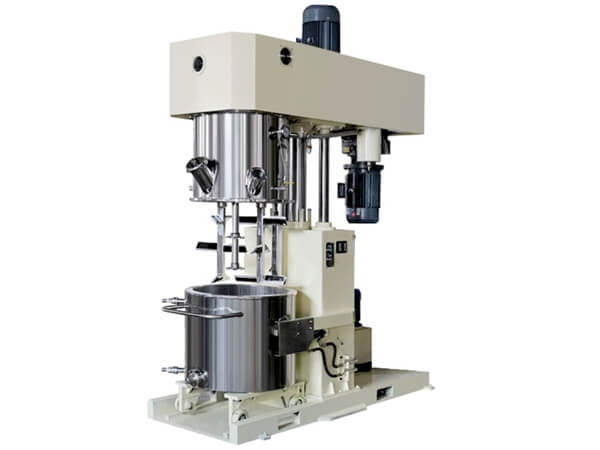
In a planetary mixer the tool rotates on its own axis while that axis orbits the centre of the vessel. The two speeds are usually independent, which lets you run high orbital speed with low blade speed, or the reverse, for different phases of one recipe. Blades carry scrapers that run against the wall, continuously peeling material off and folding it back to the centre.
- Wall contact: no dead ring and no cavity - the whole batch stays in motion, which is exactly what a thick paste needs.
- Low tip speed, gentle shear: product structure survives. That matters on aerated fillings, whipped creams and fibre-containing pastes.
- Heat transfer: in thick material, heat crosses the wall mainly by conduction, and conduction only works while fresh material keeps arriving at the surface. The scrapers are doing thermal work, not just mixing work.
- High-solids masses: dough, sealant, putty, gum base, pigment concentrate - material that would never reach a rotor-stator head at all.
What planetary mixing does not do well is fine dispersion. It moves the batch; it does not drive intense shear through it. If your specification carries a droplet size, a grind fineness or a dispersion rating, a planetary mixer on its own will usually miss it - which is why so many paste lines end up carrying a second, faster shaft in the same vessel.
Side by side: the five criteria that actually differ
1. Viscosity range
High-shear: comfortable from water-thin up to the low tens of thousands of cP, depending on head design and whether the vessel has a sweep. Planetary: from mid-range pastes up to several hundred thousand cP, and on into non-Newtonian masses better described by yield stress than by viscosity. Where the two ranges overlap, decide on the criteria below rather than on the viscosity number alone.
2. What the shear is for
A high-shear mixer creates shear on purpose, to change the product - smaller droplets, finer particles, faster hydration. A planetary mixer avoids shear on purpose, to move the product without changing it. If the recipe needs a particle or droplet size reduction, the rotor-stator head is doing a job the planetary blade cannot do. If it needs gentle folding, the reverse holds, and adding shear will cost you the structure you are trying to build.
3. Batch turnover
Turnover is how many times the whole vessel volume passes through the working zone per minute. In a thin batch a rotor-stator head turns the vessel over many times a minute, which is why cycles are short and the result is uniform. A planetary mixer turns the batch over far more slowly: uniform distribution takes minutes rather than seconds, and homogeneity depends on blade profile and cycle time rather than on shear intensity.
4. Heating, cooling and vacuum
Both machines can be jacketed and both can run under vacuum, but for different reasons. On a high-shear vessel vacuum is usually about deaeration and about dust control while charging powders. On a planetary vessel vacuum is often essential before filling, because a thick paste holds entrained air that no amount of settling will remove. On heating, the planetary scraper is the better mechanism in thick product, while a thin product in a jacketed vessel with a high-shear head heats faster simply because it convects.
5. Discharge and cleaning
Thin product drains from a bottom valve and the vessel cleans in place quickly. Thick product usually needs a discharge screw, a ram or a tilting vessel, and the points inspectors go straight to are the scraper holders, the blade roots and the valve cavity. This is where paste projects most often underestimate total cost: the mixer is one line item, and getting the batch out of it is another.
The grey zone, and the two mistakes buyers make
Between roughly 10,000 and 50,000 cP - thick lotions, ketchup, mayonnaise, toothpaste while it is still warm, resin and adhesive premixes - either machine can be made to work, and the decision usually turns on what else the vessel has to do in the same cycle.
The first mistake is buying a high-shear mixer for something too thick. The symptoms are predictable: motor load climbing through the cycle, the batch cavitating around the head instead of flowing through it, an untreated ring at the wall, and a cycle time that never matches the datasheet. Remedying it afterwards means adding a sweep or transferring the batch to a second vessel - both more expensive than specifying it correctly the first time.
The second mistake is buying a planetary mixer to make a fine emulsion. It will blend the product beautifully and still miss the droplet size or the grind, which surfaces weeks later as separation in the pack. Where stability follows particle size, the planetary mixer is the wrong primary tool, however well it distributes the batch.
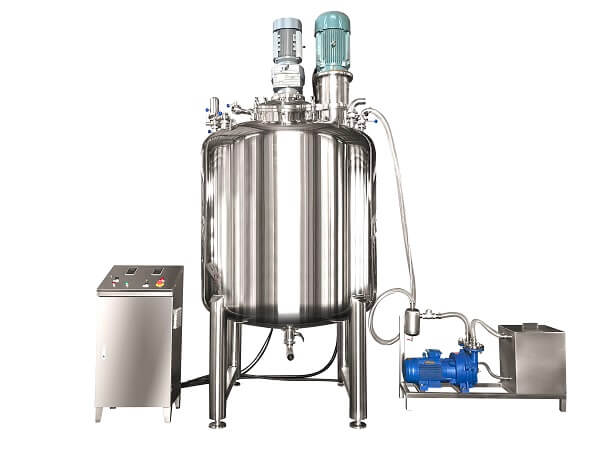
The common resolution is a vessel that carries both mechanisms: a slow scraper sweep for turnover and wall contact, plus one or two faster shafts for dispersion. Depending on the duty that can be a high-shear mixer fitted with a scraper sweep, a double-shaft LZ where the work is heavy kneading, or a triple-shaft SZ where you need slow sweep, disperser and emulsifying head running together. It costs more than either single machine and less than two vessels plus the transfer between them.
What to specify on either machine
- Viscosity and flow curve across your real process range, plus the cold-start condition - this is the number that sizes the drive and the gearbox.
- Working volume and batch weight at your viscosity, not the vessel's geometric volume.
- SS316L contact parts, mirror-polished Ra ≤ 0.4 µm - ask which surfaces are included; blade roots and frame welds are sometimes excluded by default.
- No dead corners - full CIP readiness: ground welds on the product side, no exposed threads in the product zone.
- EN 10204 3.1 mill certificates for contact steel, so the material is traceable at audit.
- CE certified - confirm the declaration covers the machine as supplied, including any optional shaft, jacketing or vacuum package.
- Discharge method, outlet height and connection type, matched to the filler at the same time as the mixer, not after it.
- Spare parts and lead times - scrapers, seals and stator heads are what you will actually re-order.
Two additions depending on the industry. If you charge dry powders that generate dust, or run alcohol-based flavours, ask about ATEX-compatible construction - zone classification is available on request, and it is far cheaper to build in than to retrofit. For cosmetics, ask for ISO 22716 cosmetics GMP-ready design. For pharmaceutical ointments and gels, ask for GMP-compliant design to EU GMP Annex 1, and for 21 CFR Part 11 ready for process control if the batch record has to be electronic.
Then settle it with a trial. Send your material and batch size to a supplier and ask for a run on your own product - on a lab-scale mixer if the batch is small, or at factory acceptance if it is production scale. On viscosity-driven decisions, paper specifications agree with each other far more often than machines agree with paper.
The bottom line
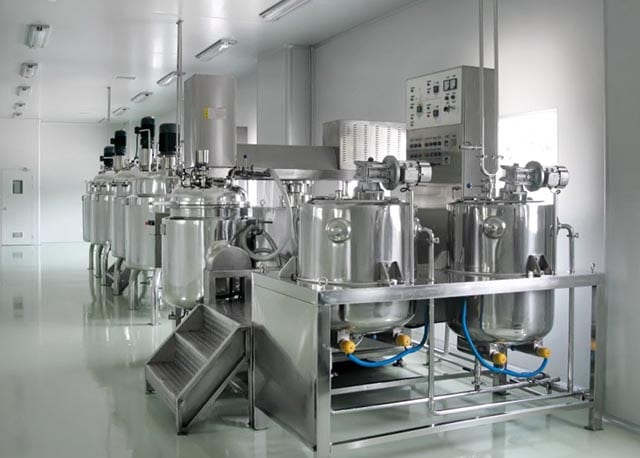
High-shear mixers and planetary mixers are not competing answers to one question - they work in different viscosity regimes. Below roughly 10,000 cP the high-shear head wins on cycle time and on anything that depends on droplet or particle size. Above roughly 50,000 cP the planetary mixer wins, because the material will not travel to the tool and the tool has to travel to the material.
In the band between them, decide on what else the vessel must do: planetary for gentle folding and wall heat transfer, high-shear for dispersion and deaeration, and one vessel with a scraper sweep plus a faster shaft where you genuinely need both.
Either way, the deciding number comes from a trial on your own material at your own batch size. Our high-shear mixer range, planetary mixers and multi-shaft mixers cover both ends and the middle - send the viscosity, the batch size and what the finished pack has to look like, and start there.
FAQ about High Shear Mixer vs Planetary Mixer: Which One for Your Product
What viscosity separates high-shear from planetary?
Below roughly 5,000–10,000 cP a high-shear mixer circulates the batch; planetary handles mid-range pastes up to several hundred thousand cP. The 10,000–50,000 cP band is the grey zone.
Can a planetary mixer make a fine emulsion?
It will blend the product beautifully and still miss the droplet size or the grind, which surfaces weeks later as separation in the pack. Planetary mixing does not drive intense shear through the batch.
What are the symptoms of running a high-shear mixer on something too thick?
Motor load climbing through the cycle, the batch cavitating around the head instead of flowing through it, and an untreated ring at the vessel wall.
Is there one machine that does both?
Yes — a vessel carrying both mechanisms: a slow scraper sweep for turnover and wall contact, plus one or two faster shafts for dispersion.
Ask an engineer about your process
Four fields are all we need to come back with the right configuration. An engineer replies, not a sales bot.
Continue reading
Planetary Mixer Buying Guide for High-Viscosity Food Pastes
How to size a planetary mixer for peanut butter, chocolate spread and filling creams - working volume, blade choice, heating, vacuum and discharge.
Read article → INDUSTRY APPLICATION · 2026-09-29Toothpaste Manufacturing: Mixing Equipment for Every Formula
Abrasives, gums and foaming surfactant in one vessel: how toothpaste is mixed at production scale, and what to specify on the machine.
Read article → TROUBLESHOOTING · 2026-09-22Cream Separating? Vacuum Emulsifier Problems and Practical Fixes
Separation, bubbles, grit, drifting viscosity: the defects that ruin a cream batch, and the vacuum emulsifier checks that fix each one.
Read article →Have a process question?
Send it to our engineers. We read every inquiry, and an engineer replies personally.
Ask an Engineer →